Biodegradable soap does break down, but only when soil bacteria get time to work on it. Rinse your hands at the edge of a snowmelt lake after eight miles of trail grime, and the soap stays in the water instead. That's why we judge the best soap for backpacking and hiking by how little it leaves behind, and how gentle it feels on your hands comes second.
We follow Leave No Trace, the outdoor ethic most land managers teach, through every step below.. You'll learn what to look for on an eco-friendly soap for camping label, why some landscapes need extra care, and how to wash up without fouling water that wildlife and the next hiker depend on. The right pick also keeps bugs and curious animals from wandering into your camp.
TL;DR Quick Answers
Best Soap For Backpacking And Hiking
The best soap for backpacking and hiking is the one that leaves the least behind. Pick an unscented, plant-based, concentrated soap for dishes and body, and pair it with a rinse-free hand cleanser that physically lifts grime off without any water, so your most frequent wash creates no greywater.
Hands: Rinse-free and plant-based. Rub a dime-sized drop on dry hands until it clumps, brush it off, and pack out the residue.
Dishes and body: A few drops of unscented, concentrated soap with no phosphates, SLS or synthetic fragrance.
Where to wash: At least 200 feet, about 70 big steps, from lakes, streams and camp.
Wastewater: Scatter it widely or bury it in a cathole 6 to 8 inches deep.
Skip: Scented soap, which draws bugs and animals, and any soap in a water source, biodegradable or not.
Top Takeaways
Biodegradable isn't water-safe. Soap needs soil and bacteria to break down, so keep it out of lakes and streams.
Fragile places raise the stakes. Alpine lakes, desert potholes and busy camps show the effects of soap first.
Unscented and plant-based wins. Skip phosphates, SLS, synthetic fragrance and dyes, and you'll draw fewer bugs and animals too.
The 200-foot rule applies every time. Wash about 70 big steps from water, then scatter the wastewater or bury it in a cathole 6 to 8 inches deep.
Using less water is the bigger win. A rinse-free hand cleanser takes greywater out of your most frequent wash.
What Biodegradable Actually Means On A Soap Label
The word means microbes can break the soap down over time. It says nothing about where you're allowed to use it.
That breakdown happens in living soil, where bacteria do the work. In water, soap can stay in solution and drift downstream. Many camp soap makers say so in their own fine print, and they tell you to wash 200 feet from water and pour the rinse into a cathole. The best waterless hand soap can help reduce the need for rinsing while you're on the trail. Read the back of the bottle before you trust the front.
Why Fragile Ecosystems Need Extra Care
In places with very little water or very few nutrients, a small splash of soap has an outsized effect.
Alpine Lakes And Snowmelt Streams
High, cold lakes start out nutrient-poor. Phosphorus is one of the main limits on what can live in them, so any extra phosphorus, from soap or anything else, can feed algae and pull oxygen out of the water. These lakes also hold fewer species and face harsher conditions, which leaves them less able to absorb pollution.
Desert Potholes And Scarce Water
Out in dry country, one pothole might be the only water for miles. Wildlife counts on it, and so does the next thirsty hiker. Sunscreen, bug spray and body oils can foul these pools too, so keep soap and skin products out entirely. On the walk to your wash spot, stick to rock or sand and step around the dark, crusty cryptobiotic soil.
High-Use Camps And Trail Corridors
A single hiker's soap barely registers. Multiply it by every party that camps at the same lake all summer, and the shoreline starts to show it. Popular spots concentrate the impact, which makes the rules matter most where everyone wants to pitch a tent.
How To Choose Biodegradable Soap For Backpacking
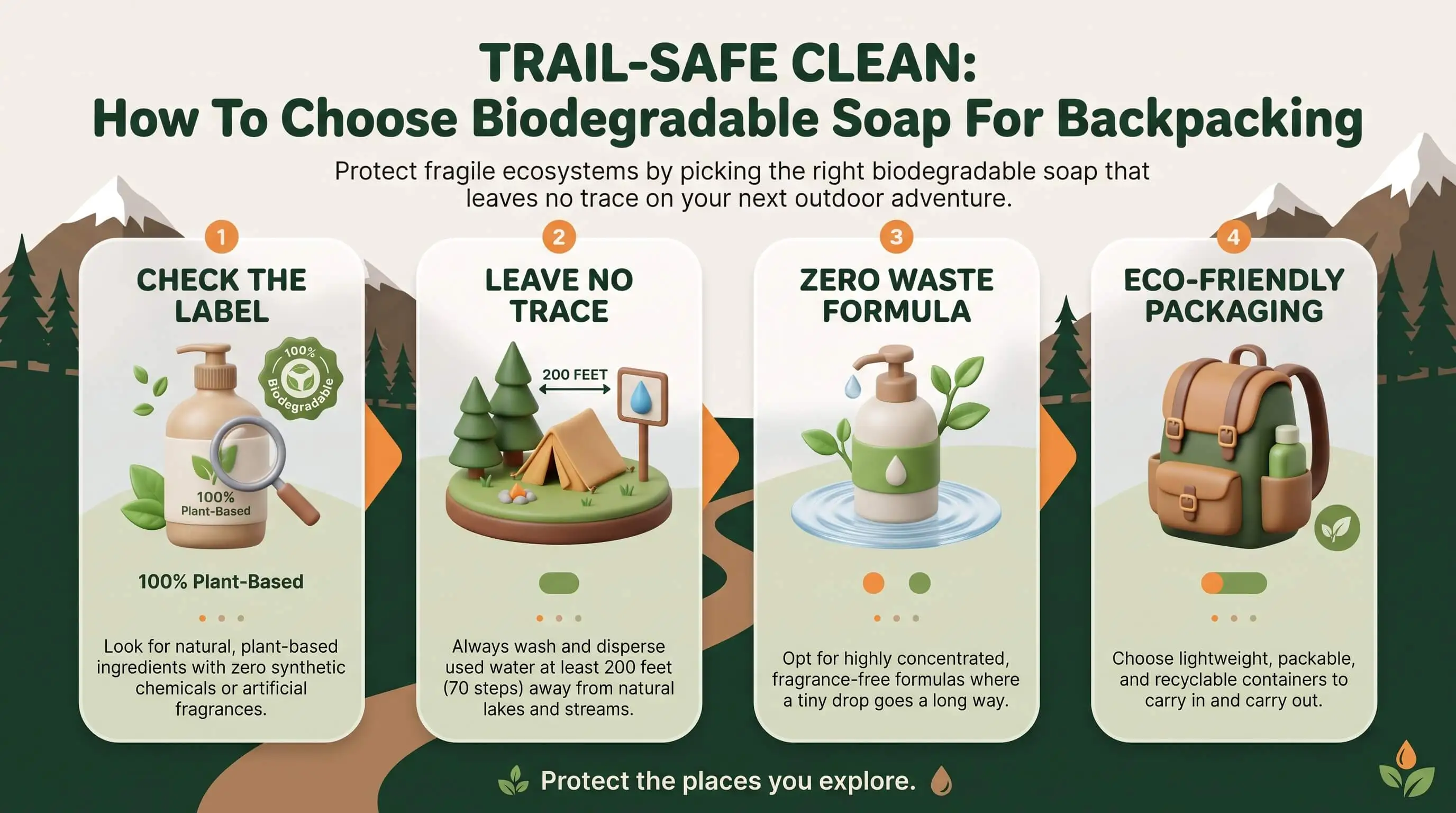
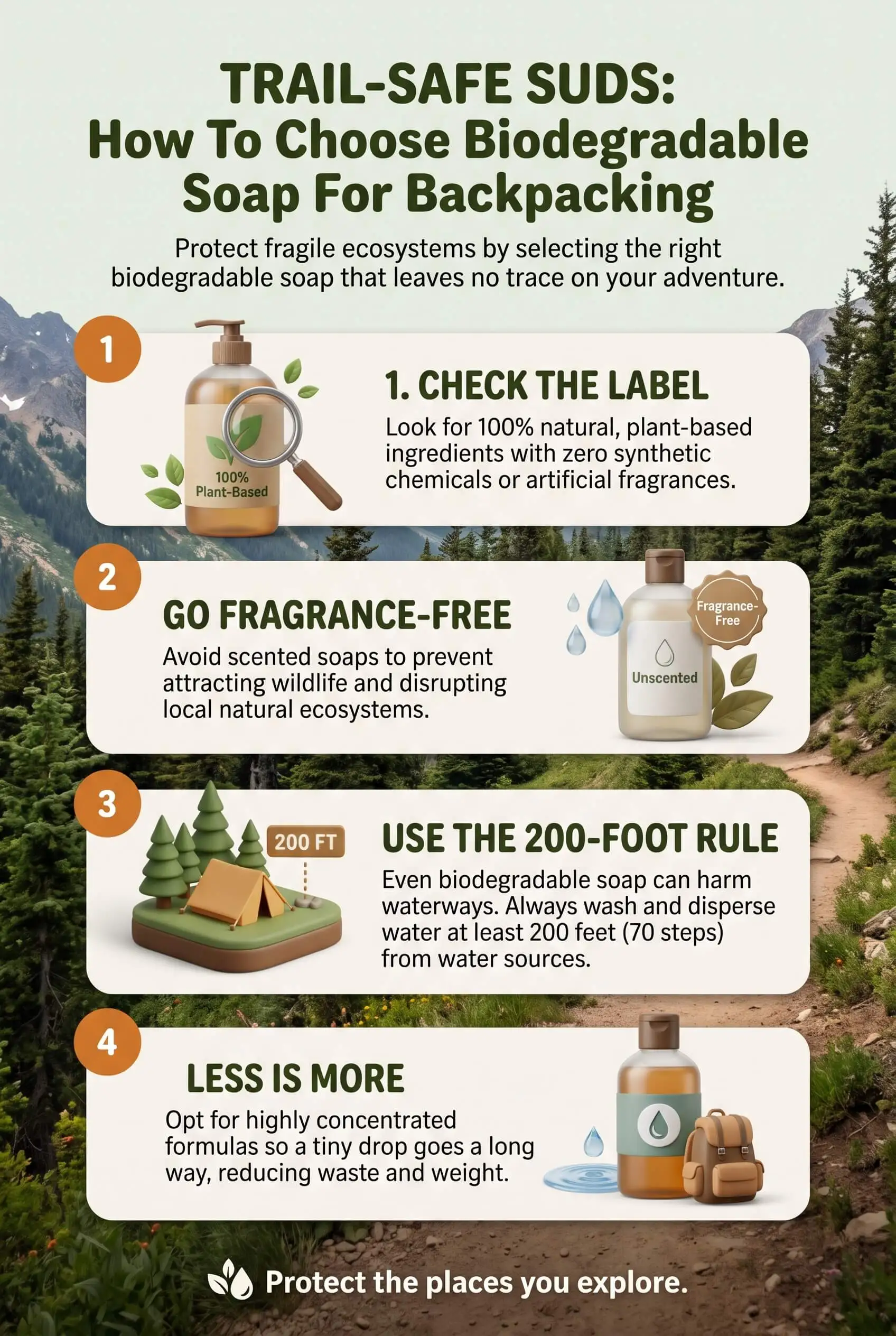
Run any soap through these six checks before it earns a spot in your pack.
Plant-based ingredients. Skip phosphates, SLS and SLES, parabens, synthetic fragrance and dyes. Look for an SLS free soap that's gentler on sensitive skin.
Unscented formula. Fragrance can draw insects and curious animals to camp, and in bug and bear country that's a problem you don't need.
High concentration. A few drops should handle one wash, which keeps the bottle small and the weight down.
Leak-proof packaging. Liquids leak in packs, while bars, powders, sheets and tubes stay put.
Gentle on skin. Days of cold water and wind crack hands fast, and a mild formula keeps them working.
Low water demand. This one matters most in fragile places, because less rinse water means less greywater to carry and scatter.
Backpacking Soap Formats Compared
Each format trades something away. Here's how they stack up on the trail.
Concentrated liquid: needs water, carries a higher leak risk and creates greywater. Best for dishes, body and laundry.
Bar: needs water and creates greywater, but it can't leak. Best for body and hair on long trips.
Powder: needs water and creates greywater, but it can't leak. Best for ultralight, all-purpose use.
Soap sheets: need a little water, can't leak and leave little greywater. Best for quick handwashing.
Rinse-free hand soap: needs no water, can't leak and leaves no greywater. Best for hands before meals and after the cathole.
For hands in the most sensitive terrain, rinse-free comes out ahead. NOWATA makes a plant-based, alcohol-free formula built on tapioca starch and a coconut-derived cleanser, and it makes a strong case as the best soap for backpacking and hiking when you have no water to spare. Rub a dime-sized drop on dry hands until it clumps, then brush the clumps away. Skip the rinse, and there's no greywater to manage. Brush the residue into your trash bag and pack it out. You'll still want a small liquid or bar soap for dishes and body washing.
How To Wash Up Without Harming The Backcountry
Collect water in a pot or bottle, and never wash in the source itself.
Walk at least 200 feet, about 70 big steps, from lakes, streams and camp.
Use a few drops of soap, or none at all for a quick rinse.
Scrub with a bandana or cloth to stretch a little soap further.
Strain out food scraps and pack them out.
Scatter the wastewater widely, or pour it into a cathole 6 to 8 inches deep.
Check the local rules before you go, since some parks and forests set stricter ones.
"On the first group trip I ever led into the high country, a hiker in our party lathered up right at the edge of a snowmelt tarn. He was proud of that biodegradable label. The next morning I could see a faint film along the shoreline, and the tarn had no outlet to flush it out. I packed differently after that. Now I carry a thumb-sized bottle of unscented castile for the pot and a rinse-free cleanser for my hands. My hands need cleaning ten times a day and my pot needs it once, so the hand cleanser does most of the work. Over five days, that adds up to liters of water I never haul 200 feet and scatter. The cleanest camp I ever made was the one where nobody could tell I'd washed at all."
7 Essential Resources
The Official Word On Biodegradable Soap
Leave No Trace lays out why biodegradable products still leave a mark, and why soap belongs 200 feet from water and down a cathole.
Source: Leave No Trace, The Skinny on Soap
How To Do Dishes The Leave No Trace Way
This step-by-step guide covers hauling water 70 big steps away, straining scraps and getting rid of dishwater the right way.
Source: Leave No Trace, How to Do Your Dishes in the Backcountry
Why Biodegradable Isn't A Free Pass
Backpacker reads the label fine print and explains why breakdown takes time and the right bacteria.
Source: Backpacker, Your Biodegradable Soap Isn't as Eco-Friendly as You Think
Busting The Camp Soap Myth
A longtime hiker makes the case for keeping every kind of soap out of water sources, then shows how to dispose of soapy water with minimal impact.
Source: SectionHiker, The Truth About Biodegradable Soap in the Backcountry
Washing Your Hands Right On The Trail
The Trek explains why you need actual soap to remove germs like norovirus, and where hand sanitizer falls short.
Source: The Trek, How to Wash Your Hands on a Backpacking Trip
What Makes Alpine Lakes So Sensitive
Researchers show how scarce phosphorus limits life in Rocky Mountain alpine lakes.
Source: Phys.org, Climate Change and Its Effects on Rocky Mountain Alpine Lakes
Pollution Risk In Remote Mountain Waters
This review explains why mountain lakes are especially vulnerable to chemical pollution, tourism included.
Source: Mountain Research Initiative, Pollution Risk for Mountain Lakes
3 Statistics
63.4 Million Americans Went Hiking In 2024
That record works out to about 20.5% of Americans ages 6 and up, and the hiking crowd has nearly doubled since 2012. More boots on the trail put more soap near the water.
Source: Outdoor Industry Association, The Hiking Boom Isn't Slowing Down
National Parks Logged More Than 323 Million Recreation Visits In 2025
The National Park Service counted 323,014,305 recreation visits and over 13 million overnight stays. Every one of those campers decided what to do with their wastewater.
Source: National Park Service, 2025 Visitation News Release
Handwashing Cuts Respiratory Illness By 16% To 21%
The CDC reports that washing hands reduces respiratory illnesses like colds in the general population by 16% to 21%. So skipping hand hygiene to protect the water won't help anyone. A lower-impact way to clean your hands will.
Source: CDC, Clean Hands Facts and Stats
Final Thoughts And Opinion
Here's our honest read. The biodegradable label has confused more hikers than it has protected lakes, because it lets people believe the bottle handles the ethics for them. Where you wash and how much water you dirty matter far more than any brand name.
So pack less:
For dishes and body: one small, unscented, multi-use soap.
For hands: a rinse-free cleanser, since that's where most of your washing happens.
For every wash: the 200-foot rule, even when you're tired and the lake sits right there.
While the greenest label makes a nice promise, the best soap for backpacking and hiking is the one that leaves the place exactly as you found it.
Frequently Asked Questions
What Is The Best Soap For Backpacking And Hiking?
The best soap for backpacking and hiking is unscented, plant-based and concentrated, with no phosphates or SLS. Most hikers do well with a small multi-use soap for dishes and body, paired with a rinse-free cleanser for hands. That setup keeps your pack light and your greywater close to zero.
Is Biodegradable Soap Safe To Use In Lakes Or Streams?
No. Soil bacteria break biodegradable soap down, and water can't do that job, so the soap lingers and spreads instead. Leave No Trace advises keeping every kind of soap out of water sources, because it can raise nutrient levels and harm aquatic life.
How Far From Water Should I Use Biodegradable Soap?
Go at least 200 feet, or about 70 big adult steps, from lakes, streams and your camp. Carry water to your wash spot in a pot or bottle instead of washing directly in the source.
How Long Does Biodegradable Soap Take To Break Down?
Nobody can give you a fixed timeline. Soil bacteria, temperature and moisture all set the pace, and in water the process crawls. That's why scattering wastewater over soil, or burying it in a cathole 6 to 8 inches deep, beats any shoreline rinse.
Should I Use Unscented Soap In Bear Country?
Yes. Fragrance can attract insects and curious wildlife, so unscented soap is the safer pick. Store your soap and other toiletries with your food, using whatever bear canister or hang method your area requires.
Is Hand Sanitizer Enough On The Trail?
Sanitizer falls short on its own once your hands are visibly dirty. It doesn't lift grime, and it does a poor job against germs like norovirus. Before you eat or cook, reach for a cleanser that physically removes dirt and germs. Even after handling supplies used for a professional pest control service around a campsite, proper hand cleaning is essential.
Pack Smarter Before Your Next Trip
Dump your hygiene kit on the floor tonight and swap anything scented for an unscented version. Then cut the pile down to one small multi-use soap and an all natural non toxic hand soap that works without rinsing. Look up the rules for the park or forest on your route, and share the 200-foot rule with everyone in your group. Leave that lake untouched, and the next hiker gets to enjoy it just as you did.