Here's what I told her. SLS free and antibacterial describe two different things on a soap label. One is about the kind of cleaning ingredient inside the bottle. The other is about a federally regulated health claim. Once you see them as separate, the label math stops feeling like a trick.
TL;DR Quick Answers
sls free soap
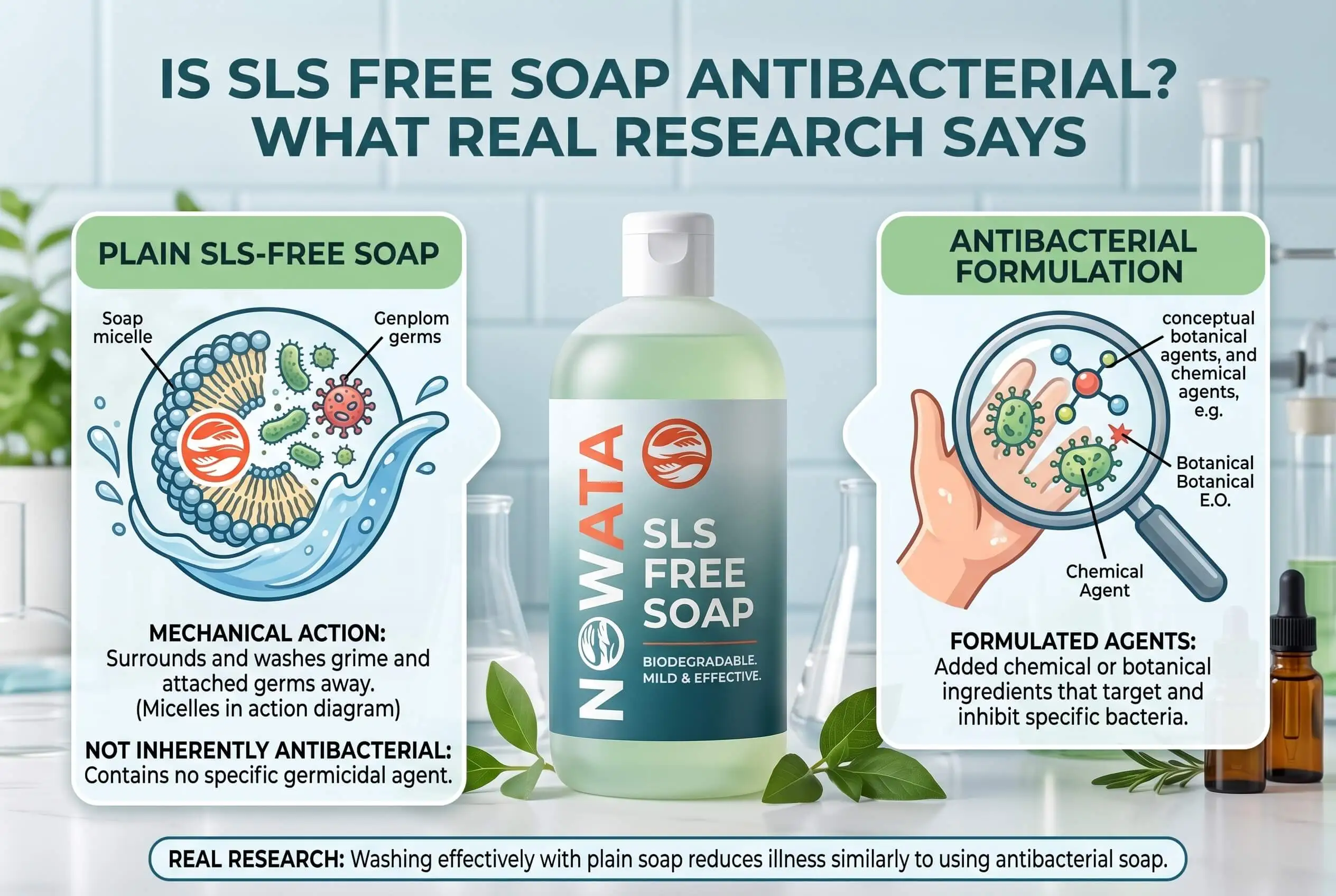
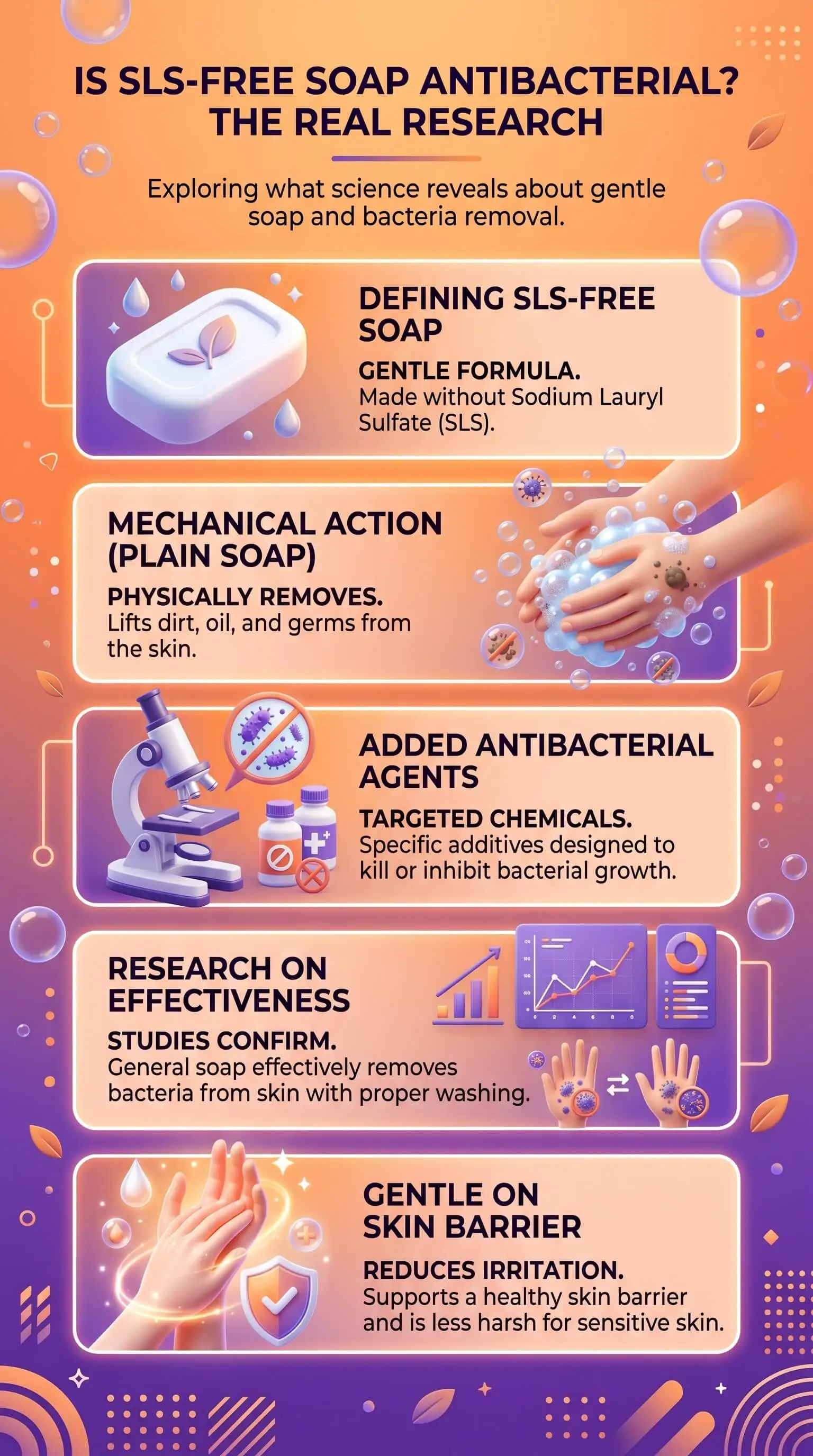
SLS free soap is a hand or body soap formulated without sodium lauryl sulfate, the standard foaming surfactant in most conventional soaps. It uses gentler cleaning agents like decyl glucoside, coco-glucoside, or sodium cocoyl isethionate instead. It still removes germs effectively, it's easier on sensitive skin, and it isn't automatically antibacterial. That's a separate FDA-regulated claim.
Key facts:
Cleaning mechanism: the same as any soap, through surfactant action, friction, and water rinsing.
Skin compatibility: SLS is the standard control irritant used in dermatology patch testing, so SLS free formulas are notably gentler.
Not antibacterial by default: a soap is only legally antibacterial if the bottle has a Drug Facts panel listing an FDA-approved active ingredient.
Best for: sensitive skin, eczema-prone hands, young kids in the house, or anyone who wants a shorter, clearer ingredient list.
What matters more than the label: your handwashing technique. Twenty seconds under clean running water is what actually clears germs.
Top Takeaways
• SLS free and antibacterial describe two different things. One is about what surfactant a soap uses. The other is a regulated drug claim.
• Taking SLS out of a soap doesn't make the soap antibacterial. Leaving SLS in doesn't either.
• A soap is only legally antibacterial if its Drug Facts panel lists an FDA-permitted active ingredient.
• The FDA itself has said plain soap and water, washed properly, handles daily germ removal about as well as antibacterial soap does.
• SLS free soap still removes bacteria and viruses from the skin when you scrub for at least twenty seconds under clean running water.
• For sensitive skin, eczema-prone hands, or young kids in the house, SLS free soap is usually the more comfortable daily choice.
• Ingredient transparency, in my experience, is a better signal of quality than any buzzword on the front of a bottle.
What SLS Actually Does in a Soap
Sodium lauryl sulfate, or SLS, is a surfactant. Its job is to cut the surface tension of water so the water can grab the oils, dirt, and microbes hiding on your skin and send them down the drain when you rinse. That's cleaning work. It isn't the same thing as chemically killing bacteria on contact, which is what an antibacterial active ingredient does. The chemistry is all on Wikipedia's sodium dodecyl sulfate entry if you want the full breakdown. What matters at your sink is simpler. SLS lifts things off your skin. It doesn't kill them.
When a bottle says SLS free, the manufacturer has swapped SLS for a gentler surfactant. Common alternatives you'll see on the ingredient panel are decyl glucoside, coco-glucoside, sodium cocoyl isethionate, and lauryl glucoside. They all clean. They just tend to be less drying and less likely to set off sensitive skin.
What "Antibacterial" Legally Means on a Soap Label
Here's where most people get tripped up. Antibacterial isn't a mood or a marketing style. It's a regulated drug claim under FDA rules. In September 2016, the FDA finalized a rule pulling 19 antibacterial active ingredients from consumer hand and body washes, with triclosan and triclocarban among the best known. Manufacturers hadn't produced data showing the ingredients were either safer or more effective than plain soap and water for everyday use, so the ingredients had to go.
What that means at the store. Any soap marketed today as antibacterial has to list a specific FDA-permitted active ingredient, such as benzalkonium chloride, benzethonium chloride, or chloroxylenol, inside a Drug Facts panel on the bottle. If there's no Drug Facts panel and no active ingredient listed, the soap isn't legally antibacterial, no matter what the front of the bottle suggests.
So, Is SLS Free Soap Antibacterial?
SLS free soap is only antibacterial if it happens to also contain one of those FDA-approved antibacterial actives in a Drug Facts panel. Otherwise, it isn't. Taking SLS out of a formula doesn't add antibacterial properties, and leaving SLS in doesn't create them. The two decisions run on separate tracks.
Most SLS free soaps on the shelf aren't trying to carry antibacterial claims in the first place. They're built for gentleness, clearer ingredient lists, and skin that reacts badly to harsher surfactants. That's a different product category with a different job, not a watered-down version of antibacterial soap.
Does SLS Free Soap Still Remove Germs?
Yes, and this is the part most product pages skip past. What actually clears bacteria and viruses off your hands during handwashing is mechanical work, not chemistry. Friction from your rubbing hands plus the surfactant action of any soap lifts microbes off your skin. The water rinsing over your hands carries them down the drain. The FDA has been saying for years that plain soap and water, used properly, handles daily germ removal about as well as antibacterial soap does.
So an SLS free soap with twenty honest seconds of scrubbing under clean running water gets the job done. The label on the bottle matters far less than whether you actually scrub for the full twenty seconds.
Why People Choose SLS Free Formulas
SLS is approved for use in consumer products. It's also a well-documented skin irritant at higher concentrations and during long contact. Dermatology researchers have used SLS as the standard control irritant in patch testing for decades, specifically because it reliably produces irritant contact dermatitis on human skin. Households with young kids, eczema-prone hands, or a history of contact dermatitis tend to move toward SLS free soap for exactly that reason, much like households that prioritize a professional pest control service often prefer safer, more carefully considered solutions overall. Other people choose it because they want shorter, plainer ingredient lists across the board.
“After fifteen years of helping homeowners work through product choices, from cabinet finishes to what actually belongs under the bathroom sink, I've settled on one question that matters more than any other when it comes to hand soap. Does the label tell me what's actually inside the bottle? I've stood at plenty of client sinks holding two competing bottles. One would shout antibacterial across the front and show a surprisingly thin ingredient list on the back. The other would be an SLS free soap that spelled out every surfactant, humectant, and botanical oil by name. Nine out of ten times, the transparent bottle turned out to be the better product in practice. That doesn't mean antibacterial soaps are bad. It does mean that, in my experience, transparency is a more reliable marker of quality “
7 Essential Resources
These are the sources I come back to whenever a reader or client pushes back on something I've said about soap, surfactants, or hand hygiene. I've checked every link.
• 1. FDA — Skip the Antibacterial Soap; Use Plain Soap and Water. The FDA's own consumer-facing explanation of why the agency pulled 19 antibacterial active ingredients from consumer hand and body washes in 2016. If you only read one source on this topic, read this one. fda.gov/consumers/consumer-updates/skip-antibacterial-soap-use-plain-soap-and-water
• 2. CDC — Handwashing Facts (Clean Hands). This is where the core public-health numbers on handwashing live, along with the mechanics of how soap and water physically remove germs from skin. cdc.gov/clean-hands/data-research/facts-stats
• 3. CDC — About Handwashing. The step-by-step handwashing protocol from the CDC: wet, lather, scrub for twenty seconds, rinse, dry. Mundane, and still the thing that matters most. cdc.gov/handwashing
• 4. Wikipedia — Sodium Dodecyl Sulfate. A straightforward technical overview of SLS: what it is, how it works chemically, where it shows up, and why it sits in the surfactant category rather than the antimicrobial one. en.wikipedia.org/wiki/Sodium_dodecyl_sulfate
• 5. NIH / PMC — The Florence Statement on Triclosan and Triclocarban. A peer-reviewed consensus paper signed by more than 200 scientists and medical professionals, walking through the health concerns and missing benefits behind the two best-known banned antibacterial activities. pmc.ncbi.nlm.nih.gov/articles/PMC5644973
• 6. Cleveland Clinic — Triclosan: What It Is and Its Effects. A clinician-reviewed look at triclosan, the antibacterial active at the center of the 2016 FDA ruling, including why it was pulled and what took its place on the shelf. my.clevelandclinic.org/health/articles/24280-triclosan
• 7. PubMed — Patch Testing With Sodium Lauryl Sulfate, SLES, and Alkyl Polyglucoside. A clinical study comparing SLS against two gentler surfactants you'll often find on an SLS free soap label. It shows, with real measurements, why those alternatives tend to irritate skin far less. pubmed.ncbi.nlm.nih.gov/12641575
3 Statistics
When readers ask me for numbers instead of opinion, these are the three I pull up first.
• 1. Handwashing education cuts diarrheal illness by 23 to 40 percent. The CDC reports that teaching people to wash their hands properly, with any soap and water, reduces diarrheal illness in the general population by roughly 23 to 40 percent. The antibacterial label isn't what moves that number. The act of washing is. Source: CDC Handwashing Facts
• 2. Handwashing reduces respiratory illnesses, including common colds, by about 16 to 21 percent. The same CDC data puts the reduction in respiratory illnesses across general community populations at roughly 16 to 21 percent. Again, the benefit comes from the act of washing, not from any claim printed on the bottle. Source: CDC Handwashing Facts
• 3. The 2016 FDA antibacterial soap ban covered roughly 40 percent of all soaps then sold. Cleveland Clinic reports the FDA rule that pulled triclosan, triclocarban, and 17 other antibacterial actives from consumer hand and body washes covered about 40 percent of soaps on the market at the time. That's how mainstream the antibacterial claim had become before regulators asked for proof it actually helped. Source: Cleveland Clinic
Final Thoughts and Opinion
My own opinion, since readers always ask for it. For most households, the antibacterial label isn't the thing to shop for when you're buying hand soap. The research has been consistent for years. The FDA itself keeps saying that plain soap and water handles daily germ removal about as well as antibacterial products do, and without the longer-term questions around residue, resistance, and chemical exposure that we still don't fully understand.
What's actually worth paying for is ingredient quality and skin compatibility. A well-formulated SLS free soap gives you both, and that matters even more in the same hygiene conversation as hand sanitizer, where people are looking for products that clean effectively without adding unnecessary irritation. You get the cleaning action of a proper surfactant. You skip the irritation that SLS causes on sensitive skin. You end up with a shorter, clearer ingredient list that you can actually verify at the store, which makes it a smart complement to hand sanitizer in any skin-conscious routine. When clients ask me what to put on their sinks, that's the direction I point them. The research backs it up, fifteen years of my own sink-side conversations back it up, and my own kitchen soap does too.
Frequently Asked Questions
Is SLS the same thing as an antibacterial agent?
No. SLS is a surfactant, meaning it's a cleaning agent that helps water lift oil, dirt, and microbes off your skin. Antibacterial actives are regulated drug ingredients that chemically target bacteria. They're two different categories doing two different jobs.
Can a soap be both SLS free and antibacterial?
Yes. A soap can skip SLS in favor of a gentler surfactant and still include an FDA-approved antibacterial active like benzalkonium chloride. Flip the bottle over and look for a Drug Facts panel. If it's there, the soap is legally antibacterial.
Does SLS free soap kill viruses?
SLS free soap, used with the CDC's handwashing technique, physically removes and disrupts viruses on the skin, including the enveloped viruses that cause colds and flu. The actual work comes from surfactant action, mechanical friction, and running water. The antibacterial label isn't part of that equation.
Why did the FDA ban 19 antibacterial soap ingredients in 2016?
Manufacturers couldn't produce data showing those ingredients were either safe for long-term daily use or more effective than plain soap and water. The ban applied to consumer hand and body washes only. It didn't cover hospital or food-service antibacterial products, which continue to be used in those settings.
Is SLS actually harmful in hand soap?
SLS is approved for use in consumer products. It's also a well-documented skin irritant at higher concentrations or during long contact with the skin. People with sensitive skin, eczema, or a contact dermatitis history often notice the difference within a week or two of switching to SLS free soap.
Call to Action
If you've read this far, you already know the habit that matters most. Flip the bottle over, scan the ingredient list, and look for surfactants you can pronounce without squinting. That one habit sorts a good SLS free soap from a weak one faster than any front-label claim ever will.
When readers ask me for a well-formulated starting point, one transparent option worth looking at is Nowata's guide to buying SLS free hand soap online. They spell out their full formulation, use gentle surfactants, and hit the criteria I apply when I'm pointing clients toward a soap that cleans without irritation. Use it as a reference bar. Compare it against whatever is sitting on your sink right now. Pick the one with the clearer label. Your hands, and anyone in the house with sensitive skin, should feel the difference inside of a week.
If this piece was useful, send it to anyone who has ever stood in the soap aisle wondering which label to trust. And if you've got a follow-up question about soap, cleaning products, or household hygiene, drop it in the comments. I read them.