At Jiffy Junk, we’ve seen how often homeowners accidentally dispose of chemicals the wrong way during cleanouts. That’s why this guide breaks down how to dispose of acetone using the simplest legal options, what local regulations typically expect, and the safest way to handle small quantities—so you can dispose of acetone confidently, without guesswork.
TL;DR Quick Answers
How to Dispose of Acetone
For small household amounts, treat acetone like household hazardous waste. Keep it sealed in its original container, store it away from heat or flames, and take it to a local HHW drop-off site or collection event. At Jiffy Junk, we see the biggest problems when people “just toss it” or pour it down the drain—if it still pours, don’t guess.
Top Takeaways
Acetone is flammable. Small amounts still matter.
Never dump it down the drain or throw liquid acetone in the trash.
Best option: use a Household Hazardous Waste (HHW) drop-off or collection event.
Store it safely until disposal day (sealed, upright, away from heat/sparks).
Rule of thumb: If it still pours, treat it like hazardous waste.
What Counts as a “Small Amount” of Acetone?
For most homeowners, “small amounts” means what’s left in a typical household container—like nail polish remover, DIY cleaning acetone, or leftover solvent from a home project. In practical terms, this usually ranges from a few tablespoons up to a cup or two.
Even in small quantities, acetone is still:
Highly flammable
A VOC (volatile organic compound)
Often regulated as household hazardous waste (HHW)
That’s why disposal matters—because the safest method isn’t always the most convenient one.
The Biggest Mistakes People Make With Acetone Disposal
Before you choose a disposal method, avoid these common “quick fixes” that can cause safety issues or violate local guidelines:
Pouring acetone down the drain (can create fumes and may be prohibited)
Throwing liquid acetone in the trash (fire risk inside bins and trucks)
Mixing acetone with other chemicals (can trigger dangerous reactions)
Leaving an open container indoors (strong fumes + ignition risk)
At Jiffy Junk, we regularly see chemical leftovers during cleanouts—and acetone is one of the most common items people aren’t sure how to handle.
The Safest Legal Option: Household Hazardous Waste (HHW) Drop-Off
In most cities and counties, the cleanest and most rule-friendly way to dispose of acetone is through a Household Hazardous Waste program, such as:
City/county hazardous waste drop-off sites
Scheduled HHW collection days
Community chemical disposal events
This option is recommended because it:
Keeps acetone out of drains and landfills
Reduces fire risk
Matches the disposal method most local rules are built around
Pro Tip
Keep acetone in its original labeled container if possible—this makes drop-off faster and safer.
How to Dispose of Small Amounts of Acetone at Home (When Allowed)
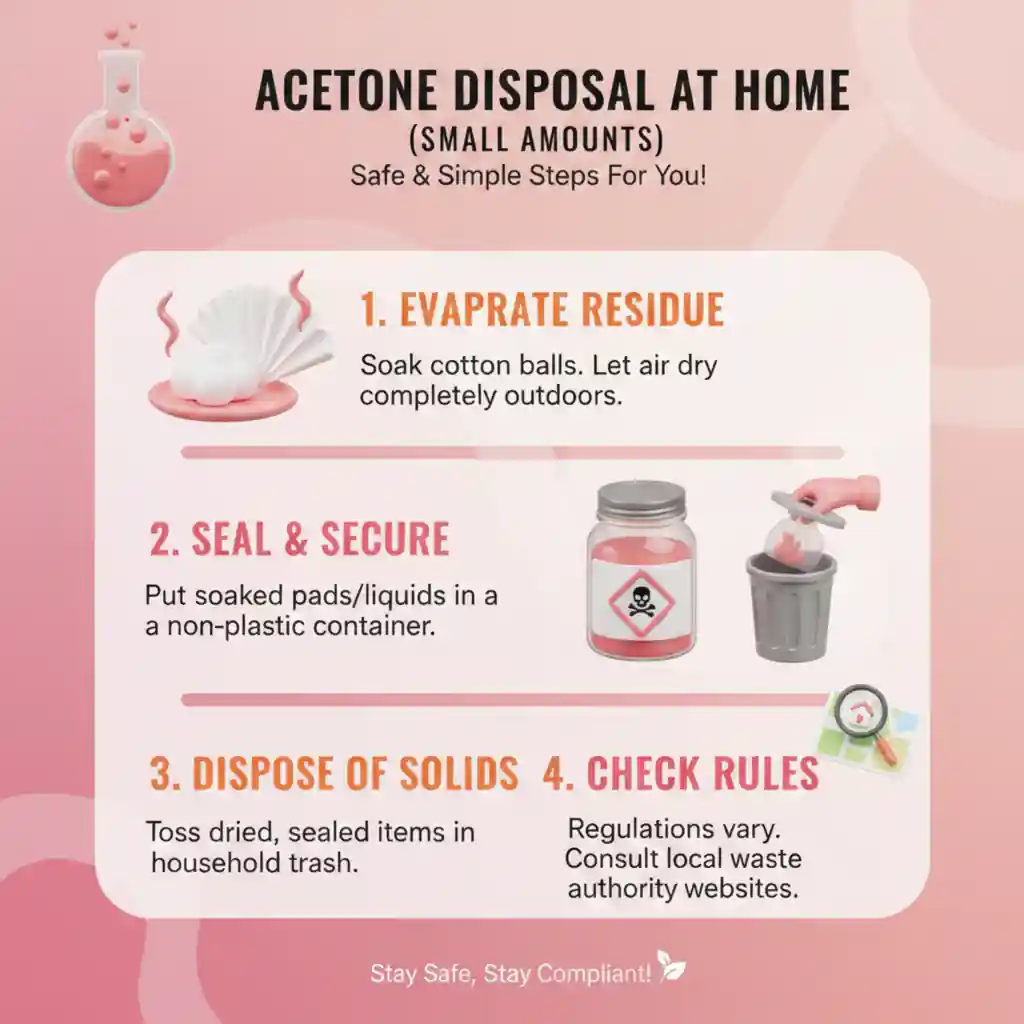
Some local rules allow limited at-home disposal methods for very small quantities, especially when acetone is fully dried or evaporated safely. If your local guidelines permit it, here’s the safest approach.
Use It Up (Best Option)
If you can safely use the remaining acetone for its intended purpose, that’s the simplest solution. Less leftover chemicals = less disposal risk.
Let It Evaporate Safely (Only in Specific Conditions)
In some areas, homeowners are allowed to evaporate tiny amounts of acetone outdoors in a controlled way.
If allowed:
Pour a small amount into a shallow metal or glass container
Place it outside in a well-ventilated area
Keep it away from flames, smoking, grills, or sparks
Keep it away from kids and pets
Once fully evaporated and dry, the empty container residue may be disposable depending on local rules
Important
Never evaporate acetone indoors or in enclosed areas (garage included). The fumes are flammable and can build up quickly.
How to Store Acetone Until Disposal Day
If you can’t dispose of acetone immediately, store it safely:
Keep it in a sealed original container
Store it upright, away from heat and sunlight
Keep it away from paint thinner, gasoline, cleaners, and bleach
Do not store near appliances, pilot lights, or electrical tools
This prevents leaks, vapor buildup, and accidental ignition.
Quick Rule of Thumb: What You Can and Can’t Do
Here’s a simple cheat sheet for small amounts.
Usually OK
Take it to HHW drop-off
Keep it sealed until disposal day
Use up what you can safely
Usually NOT OK
Pouring down sink/toilet/storm drain
Tossing liquid acetone in household trash
Burning it
Mixing with other chemicals
Because disposal rules vary by location, the safest route is always to follow your city/county HHW guidance.
When to Call a Junk Removal Team Instead
If acetone is part of a larger cleanup—like a garage cleanout, renovation debris, or leftover paint/solvents—handling everything alone can get risky fast.
At Jiffy Junk, we often help homeowners remove clutter and identify items that require special handling so they don’t accidentally violate disposal rules or create hazards. If you’re dealing with multiple chemicals, unknown liquids, or a bulk cleanup, it may be safer to bring in help.
“Acetone is one of the most common ‘small leftovers’ we see during home cleanouts—and it’s also one of the easiest to dispose of the wrong way. At Jiffy Junk, we’ve watched homeowners unknowingly toss half-full bottles into trash bags or pour them down a drain, not realizing the fire risk or local HHW rules. Our rule of thumb is simple: if it still pours, treat it like hazardous waste—seal it, store it safely, and take it to a proper drop-off site instead of guessing.”
Essential Resources
EPA Household Hazardous Waste Guide — Know the Rules Behind “Hazardous”
Before you take action, it helps to understand why acetone isn’t just ordinary trash. The EPA breaks down what qualifies as household hazardous waste and how communities handle these materials — the same kind of guidance our team keeps in mind during home cleanouts.
https://www.epa.gov/hw/household-hazardous-waste-hhw
ATSDR Toxicological Profile for Acetone — Protect Your Health While Disposing
If you’re handling acetone at home, it’s worth knowing the health and exposure risks. This federal profile explains what acetone does, how exposure happens, and what safety precautions matter most.
https://wwwn.cdc.gov/TSP/ToxProfiles/ToxProfiles.aspx?id=5&tid=1
OSHA Acetone Chemical Database — Follow Proven Safety Standards (Even at Home)
Even though OSHA is workplace-focused, their acetone data is a smart resource for homeowners. It highlights exposure limits and ventilation principles that help you avoid fumes, headaches, and unsafe handling.
https://www.osha.gov/chemicaldata/476
NOAA CAMEO Chemicals Database — Know What to Do if There’s a Spill or Fire Risk
Accidents happen—especially during DIY projects and garage cleanouts. This database provides emergency response info for acetone spills, fumes, and fire hazards, making it a great “just in case” resource to bookmark.
https://cameochemicals.noaa.gov/chemical/8
PubChem Acetone Summary — Understand Why It’s a Bad Idea to Dump It
If you want to understand the “why” behind disposal rules, PubChem explains acetone’s chemical properties and behavior. It’s helpful for seeing why pouring acetone into plumbing or septic systems can cause issues.
https://pubchem.ncbi.nlm.nih.gov/compound/Acetone
EPA Hazardous Waste Facility Locator — Find Licensed Disposal Sites Near You
If you’re dealing with more than a tiny amount—or you’re cleaning out a workshop—this EPA resource helps you locate licensed hazardous waste facilities for proper disposal.
https://www.epa.gov/hwpermitting/how-do-i-find-hazardous-waste-management-facilities-my-area
Earth911 Recycling Search — Find Local HHW Drop-Off Options Fast
Want the quickest way to find nearby disposal options? Earth911 lets you search by zip code for hazardous waste drop-offs and community collection programs—perfect for small household amounts.
https://search.earth911.com/
Supporting Statistics
U.S. Household Waste Volume
The U.S. generates ~292.4 million tons of trash per year
That equals ~4.9 lbs per person per day (2018)
Jiffy Junk insight: During cleanouts, we see how packed and compressed trash loads get—so even “small” acetone leftovers can leak, spread fumes, or create hazards fast.
Source (EPA): https://www.epa.gov/facts-and-figures-about-materials-waste-and-recycling/national-overview-facts-and-figures-materials
Acetone Fumes Can Build Up Quickly
OSHA PEL: 1,000 ppm (TWA)
NIOSH REL: 250 ppm (TWA)
Jiffy Junk insight: We often find acetone stored in garages/bathrooms with loose caps. That’s when fumes become noticeable quickly—one reason sealed storage + ventilation matters.
Source (CDC/NIOSH): https://www.cdc.gov/niosh/npg/npgd0004.html
Fire Risk Is Real (Not Hypothetical)
U.S. highway vehicle fires caused:
~$2.2 billion in direct property damage (2024)
450 civilian deaths
850 injuries
Jiffy Junk insight: Trash loads are compacted, moved, and exposed to heat/sparks. That’s why flammable liquids like acetone should never be tossed in regular trash.
Source (NFPA): https://www.nfpa.org/education-and-research/research/nfpa-research/fire-statistical-reports/fire-loss-in-the-united-states
Final Thought & Opinion
Disposing of acetone at home isn’t complicated—but it does need to be done carefully. Even small amounts can create strong fumes, increase fire risk, and fall under household hazardous waste (HHW) rules depending on your location.
The safest, most rule-friendly approach
Keep acetone sealed in its original container
Store it away from heat, flames, and sunlight
Use a local HHW drop-off site or collection event
Jiffy Junk’s real-world opinion
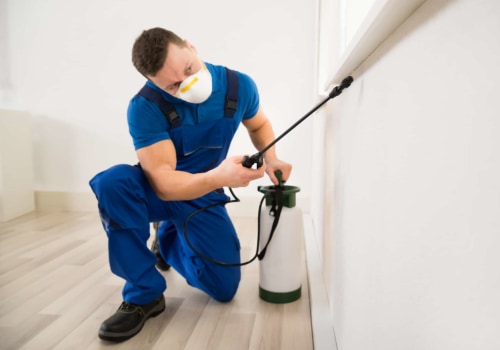
In our experience, most acetone disposal mistakes happen because it looks harmless. During cleanouts, we’ve seen half-used bottles tossed into trash bags “just to get rid of it”—but once trash is compacted and transported, flammable liquids can quickly become a serious hazard. This is why working with a professional pest control service (or any service team entering a home for treatment) should include safe chemical awareness and proper disposal planning—especially when acetone or other flammables are present.
Simple rule we follow:
If it still pours, treat it like hazardous waste.
FAQ on How to Dispose of Acetone
Q: Can I pour acetone down the drain?
A: Usually, no. Acetone may count as household hazardous waste (HHW). Drain disposal can create fumes and may violate local rules. The safest option is HHW drop-off.
Q: Can I throw acetone in the trash?
A: Not if it’s still liquid. Liquid acetone is a fire risk, especially because trash loads get compacted and transported. Rule of thumb: if it still pours, don’t trash it.
Q: What’s the safest way to dispose of small amounts of acetone at home?
A: Keep it sealed, store it safely, and take it to an HHW drop-off or collection event. In our experience at Jiffy Junk, this is the cleanest option because it removes guesswork and avoids unsafe shortcuts.
Q: Is it okay to let acetone evaporate outside?
A: Only sometimes. It depends on local regulations and should only be used for tiny amounts. Never evaporate acetone indoors or in a garage. Keep it away from sparks, flames, kids, and pets.
Q: How should I store acetone until disposal day?
A: Store it like a flammable chemical. Keep it upright and tightly sealed, and store it away from heat, sunlight, and pilot lights. In cleanouts, the most common issue we see is leaks and loose caps that cause fumes and spills.