TL;DR Quick Answers
Fridge Pick Up, Removal, Haul Away, and Disposal
Getting rid of a garage refrigerator is faster and simpler than most homeowners expect — if you know your options. Here is what years of field experience confirms:
Refrigerators cannot go out with regular trash — federal law requires certified refrigerant recovery before disposal
The fastest option is professional junk removal — one call handles disconnection, removal, and certified disposal, often same-day
If the unit still runs, check your utility provider's appliance recycling program first — many offer free pickup plus a $25 to $75 rebate
Refrigerators over 15 years old cost $95 or more per year to run — removal often pays for itself quickly
Not all haulers follow EPA disposal guidelines — always verify that refrigerant recovery and responsible recycling are part of the process
Working units in good condition can be donated through organizations like Habitat for Humanity ReStores
Drop-off options are available through certified recycling centers and municipal transfer stations for those with transport access
Bottom line: the right removal option depends on your unit's condition, your timeline, and what programs are available in your area. When speed, compliance, and accountability matter, professional junk removal is the single most reliable path from problem to solved.
Top Takeaways
A garage refrigerator can't go out with regular trash.
Contains EPA-regulated refrigerants requiring certified recovery
Curbside disposal without scheduled pickup risks fines and environmental harm
Homeowners carry legal exposure they often don't know exists
That old garage fridge is costing more than you think.
Refrigerators over 15 years old can cost $95 or more per year to run
Uninsulated garages push energy consumption even higher
Most homeowners never connect the energy drain to that specific appliance
You may be able to get paid to remove it.
Utility rebate programs pay $25 to $75 for working units
Many include free pickup at no cost to the homeowner
Most homeowners never check — checking takes two minutes
Not all removal is the same as proper disposal.
Certified refrigerant recovery is not standard across all haulers
Responsible recycling and donation routing must be verified
What happens after pickup is the question most people never ask
Professional removal is the fastest and most complete option.
One call handles disconnection, removal, disposal, and cleanup
Available same-day in most areas
In the time spent researching alternatives, the job could already be done
What Is the Easiest Way to Get Rid of a Garage Refrigerator?
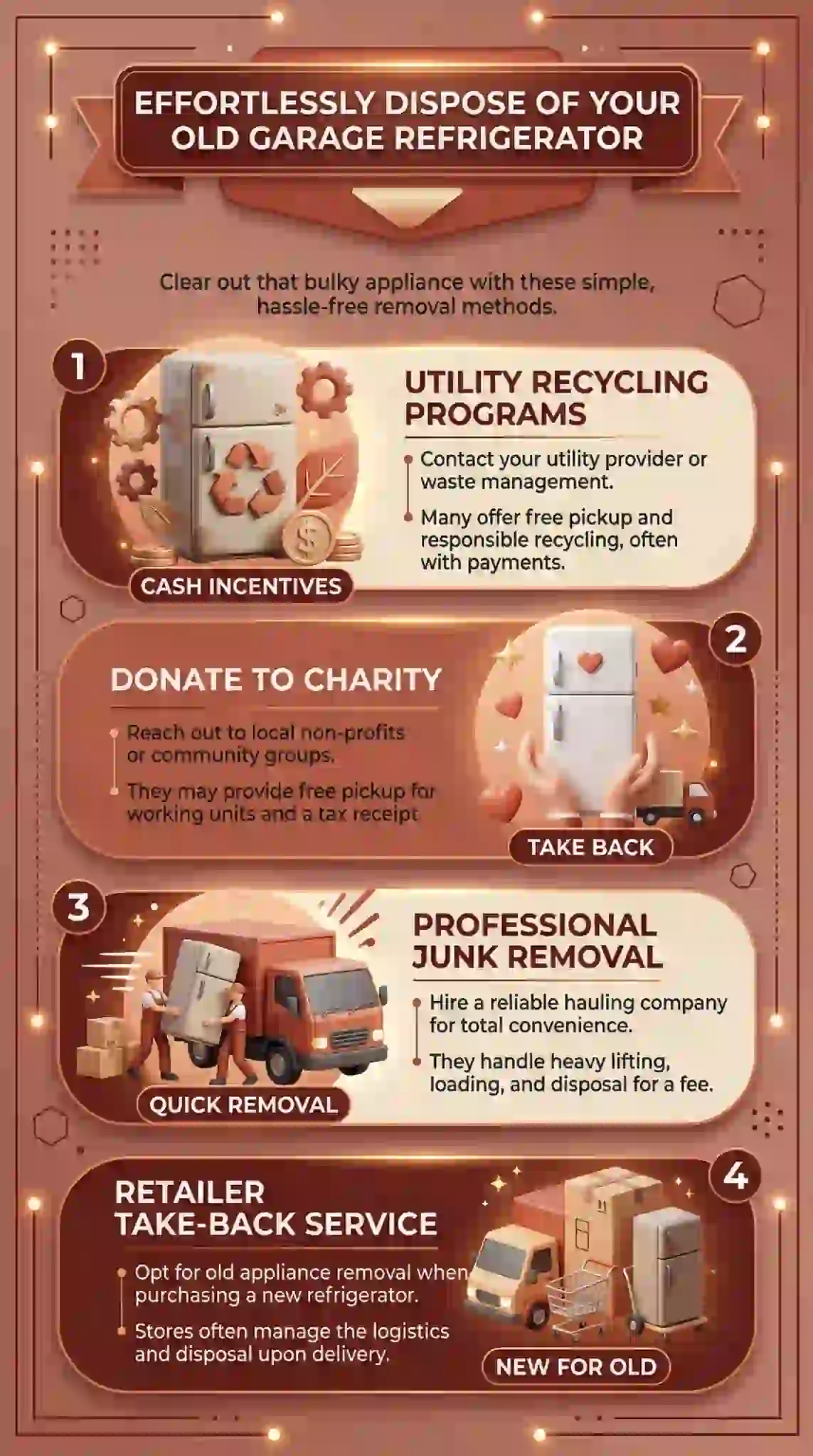
Getting rid of a garage refrigerator does not have to be a weekend project. The easiest approach depends on a few key factors — the unit's age, whether it still works, and how quickly you need it gone. Here are the most practical removal options available to most homeowners.
Schedule a Junk Removal Pickup
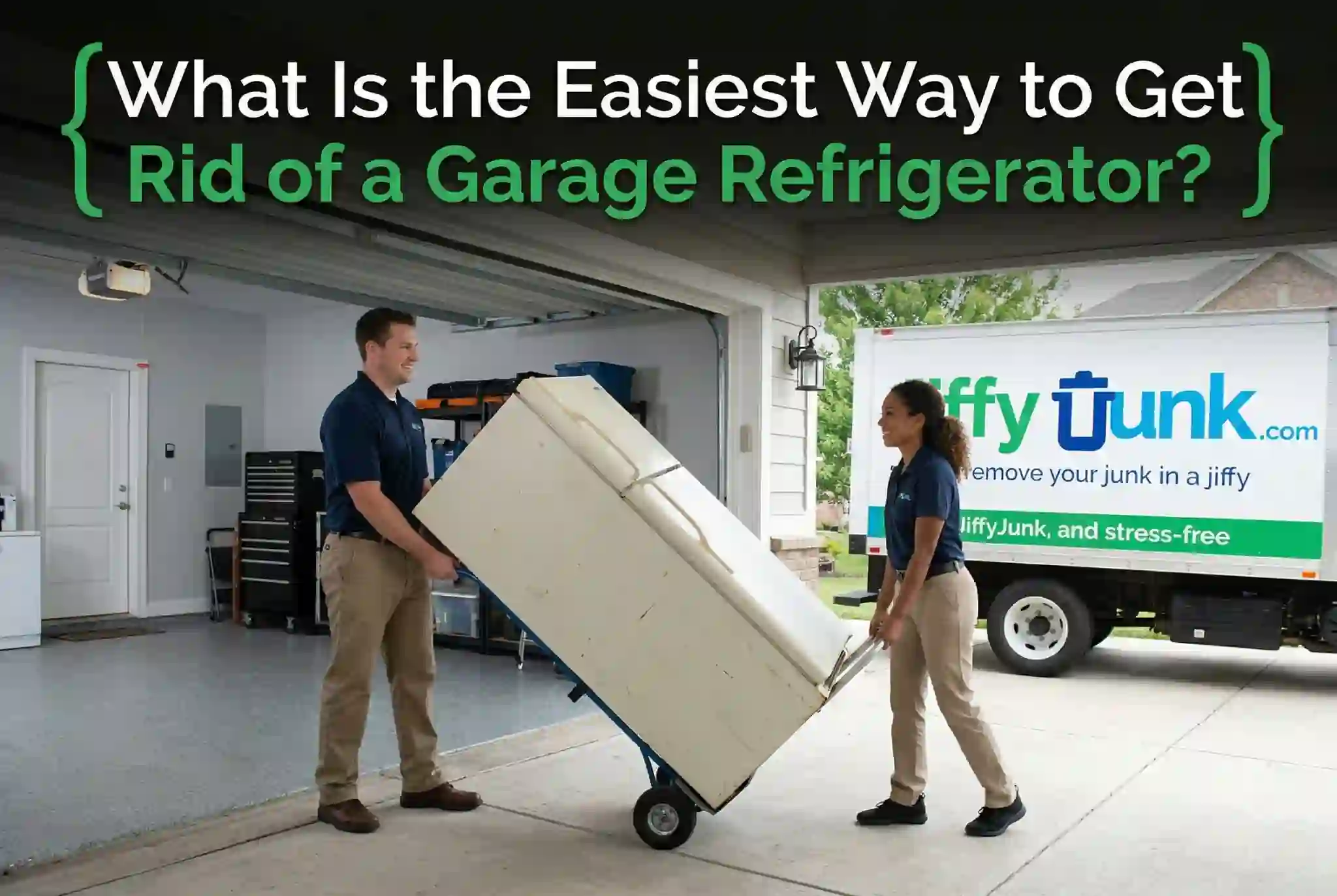
The fastest and most hands-off option is scheduling a professional junk removal service. A crew comes to your home, loads the refrigerator for you, and hauls it away — no heavy lifting, no truck rental, no trip to the dump. Most services can schedule same-day or next-day pickups, making this the go-to choice when you need the unit gone quickly.
Use a Retailer Haul-Away Program
If you are buying a new refrigerator, many major appliance retailers will remove your old unit at the time of delivery. Home Depot, Lowe's, and Best Buy all offer haul-away programs, sometimes at no additional charge. This option works best when you are already making a replacement purchase.
Donate or Sell It If It Still Works
A functioning garage refrigerator has real value. Local charities, Habitat for Humanity ReStores, and online marketplaces like Facebook Marketplace or Craigslist are reliable outlets for working units. Selling or donating keeps the appliance out of a landfill and may put money back in your pocket.
Check Your Utility Company's Recycling Program
Many utility providers run appliance recycling programs that will pick up old refrigerators for free. Some even offer a rebate of $25 to $50 for qualifying units. Contact your local utility company or visit their website to check availability in your area.
Drop It Off at a Recycling Center or Transfer Station
If you have access to a truck or trailer, dropping the unit off at a local recycling center or municipal transfer station is a low-cost option. Refrigerators contain refrigerants that require proper handling, so confirm the facility accepts appliances before you load up.
"Garage refrigerators are one of the most common items we remove, and homeowners are almost always surprised by how simple the process is. The biggest mistake people make is waiting — letting a dead or inefficient unit sit for months because they assume removal will be a hassle. In most cases, we can have it out the same day someone calls. Knowing your options ahead of time is the difference between a cleared garage and a refrigerator that sits there for another season."
Essential Resources
Know Before You Remove: 7 Resources That Make Refrigerator Disposal Easier
We know you want to handle your garage refrigerator removal the right way. Whether you're exploring rebates, looking into donation options, or simply trying to understand what federal law requires, these seven resources give you the information you need to make a smart decision — before anyone shows up at your door.
EPA Appliance Disposal Guidelines — Understand What the Law Actually Requires Refrigerators contain EPA-regulated refrigerants, and federal law requires certified recovery before any unit can be legally disposed of. This resource explains the full chain of responsibility — and helps you verify that whoever hauls your unit away is handling it correctly. https://www.epa.gov/section608/appliance-disposal
EPA Safe Disposal Requirements — Know Who Is Responsible at Every Step This page breaks down Section 608 of the Clean Air Act in plain terms, including documentation requirements and what happens when refrigerant has already been removed. It is the definitive reference for confirming your disposal method is fully compliant — and a good way to vet any hauler you're considering. https://www.epa.gov/section608/stationary-refrigeration-safe-disposal-requirements
ENERGY STAR Flip Your Fridge Calculator — Find Out What That Old Unit Is Really Costing You That garage refrigerator you've kept "just in case" may be quietly adding $95 or more to your energy bill every year. This free tool calculates the actual annual operating cost based on your appliance's age and model — and gives you a concrete number to weigh against the cost of removal. In our experience, this is the resource that finally convinces people to let go. https://www.energystar.gov/products/appliances/refrigerators/flip_your_fridge
ENERGY STAR Rebate Finder — Get Paid to Recycle Your Old Refrigerator Many utility companies will pay you $25 to $75 to take a working refrigerator off your hands — and most homeowners never check. This directory helps you find rebate programs and free pickup options available in your area. It takes about two minutes and could save you real money. https://www.energystar.gov/products/recycle/find_fridge_freezer_recycling_program
Habitat for Humanity ReStores — Give a Working Fridge a Second Life If your refrigerator still runs reliably, donating it keeps a perfectly good appliance out of the waste stream and supports families in your community. Habitat for Humanity ReStores accept working units in good condition — typically under 10 years old — and many locations offer free pickup. It is a simple way to do some good before calling in a crew. https://www.habitat.org/restores/donate-goods
Earth911 Recycling Locator — Find a Certified Drop-Off Facility Near You Not all recyclers handle refrigerators the same way. Earth911 searches over 100,000 locations nationwide to connect you with certified appliance recyclers and municipal programs in your ZIP code. If pickup services are unavailable in your area, this is the fastest way to identify a legitimate drop-off option that follows EPA guidelines. https://earth911.com/recycling-guide/how-to-recycle-large-appliances/
DSIRE Incentive Database — Search Every Available Rebate in Your State DSIRE is the most comprehensive database of state, local, and utility-based incentive programs in the country. Search by location to find appliance recycling rebates, energy efficiency upgrade discounts, and other programs that may save you money on removal or replacement. Worth checking before you commit to any path forward. https://www.dsireusa.org/
These essential resources make any garage cleanout easier by helping you navigate refrigerator disposal, understand legal requirements, explore rebates, and choose the most efficient removal option before scheduling a pickup.
Supporting Statistics
After removing thousands of refrigerators from garages and homes nationwide, we've seen what the data confirms — and in some cases, what it understates.
34% of U.S. Homes Have Two or More Refrigerators — And Most of Them Are in the Garage
The percentage of U.S. homes with two or more refrigerators has grown to 34% as of 2020, up from 30% in 2015. Those numbers match exactly what our crews encounter on the job:
The garage refrigerator is almost always the oldest appliance in the home
It's the one nobody thinks about until it stops working or the space is needed back
A garage fridge running in extreme heat or cold works harder than any average estimate accounts for
What the data doesn't capture is environment. Most homeowners we talk to have no idea what the unit is actually costing them month to month. That changes the conversation fast.
Source: U.S. Energy Information Administration — Residential Energy Consumption Survey (RECS) https://www.eia.gov/pressroom/releases/press510.php
Refrigerators Over 15 Years Old Can Cost $95 or More Per Year Just to Run
Refrigerators over 15 years old could be costing homeowners around $95 per year to operate. By properly recycling an old refrigerator and replacing it with a new ENERGY STAR certified model, a homeowner can save about $150 over the 12-year lifetime of the product.
In practice, $95 per year is often a conservative number. By the time a customer calls us:
The unit is typically well past the 15-year mark — sometimes 20 to 25 years old
It's running in an uninsulated space with a compressor that hasn't been serviced in years
The energy drain is real, but most people never connect it to that specific appliance
Sharing this data point is often what moves the decision from "eventually" to "can you come tomorrow." The unit isn't just taking up floor space — it's been on the payroll for years without justification.
Source: U.S. Department of Energy / ENERGY STAR https://www.energystar.gov/products/refrigerators
11 to 13 Million Refrigerators Are Disposed of Annually — Most Without Proper Handling
An estimated 11 to 13 million refrigerated household appliances reach end-of-life annually in the United States. Despite federal regulations, illegal activities including appliance dumping, venting of refrigerant, and release of hazardous components to the environment still occur.
The EPA's Responsible Appliance Disposal Program documented what responsible handling achieves at scale:
9 million+ refrigerated appliances properly processed
1.5 billion pounds of metals, plastics, and materials recycled
543,000+ hazardous internal components safely managed
Emissions avoided equivalent to powering 5 million homes annually
What those numbers don't show is what we see when disposal goes wrong:
Units left curbside without certified pickup scheduled
Refrigerants vented by haulers with no recovery process
Homeowners who assumed it was handled — and it wasn't
The problem isn't just volume. It's the assumption that any removal equals proper disposal. It doesn't. When you book with Jiffy Junk, your refrigerator goes to certified recycling partners, with the same level of responsibility you would expect from a professional pest control service. Working units go to donation. Nothing gets dumped, vented, or passed down a chain with no accountability.
Source: U.S. Environmental Protection Agency — Appliance Disposal / RAD Program https://www.epa.gov/section608/appliance-disposal
Final Thoughts
Getting rid of a garage refrigerator looks simple from the outside. It gets complicated the moment you start making calls. Utility programs have waitlists. Municipal pickup requires documentation. Retailers only take the old unit if you're buying new. And underneath all of it is a 200-pound appliance containing EPA-regulated refrigerants that can't legally go to the curb like a broken lamp.
We've navigated every version of this situation. Here's our honest take.
What Most People Get Wrong
The assumption we hear most often is that removal equals disposal. It doesn't. That's where things go sideways.
Most curbside removal doesn't include certified refrigerant recovery
Many haulers have no process for responsible recycling or donation
Working units that could serve another household end up in a landfill
Homeowners carry legal and environmental exposure they never knew existed
Proper disposal isn't a preference. It's a federal requirement.
What the Data and the Fieldwork Agree On
After a decade of removals and years of tracking what federal research confirms:
The older the unit, the higher the hidden cost — in energy, space, and removal complexity
Secondary garage refrigerators are disproportionately old, inefficient, and overlooked
Responsible recycling is achievable — but only with the right partners involved from the start
Homeowners who act sooner consistently say they wished they had done it earlier
That last point isn't a sales pitch. It's the single most common thing people say after the truck pulls away.
Our Honest Opinion
A garage refrigerator past its useful life isn't an asset. It's a liability — running on your electricity bill, consuming floor space, and waiting to become an emergency when the compressor finally gives out.
The easiest removal option is the one that handles everything in a single step:
Disconnection
Removal from anywhere in the home
Certified eco-responsible disposal
Complete cleanup before we leave
That option exists. It's available same-day in most areas. And in the time most homeowners spend researching alternatives, the job could already be done.
Reclaim the space. Eliminate the expense. Do it once and do it right.
FAQ on Fridge Pick Up, Removal, Haul Away, and Disposal
Q: What is the easiest way to get a refrigerator picked up and hauled away?
A: The easiest option is the one that handles everything in a single call. After removing thousands of refrigerators nationwide, the answer is always the same — professional junk removal eliminates every variable:
No truck rental
No refrigerant compliance research
No coordinating multiple programs with different eligibility requirements
A crew shows up, disconnects the unit, removes it from wherever it sits, and handles disposal start to finish. One tip we always give: if your unit is still running, check your utility provider's appliance recycling program first. Some pick it up for free and hand you a rebate check on the way out. It takes two minutes and occasionally saves homeowners the entire cost of removal.
Q: Can I leave my old refrigerator at the curb for trash pickup?
A: In most cases, no. This is the most common misconception we encounter. Here is why curbside placement fails:
Federal law requires certified refrigerant recovery before legal disposal
Most municipal waste services won't collect a refrigerator without documentation
Many bulk pickup programs require proof of prior refrigerant removal
Units left curbside without scheduled pickup are frequently mishandled
We've arrived at properties where a previous hauler left a unit curbside assuming the city would handle it. Weeks later, the refrigerator was still there. Always confirm with your local Department of Public Works first — or use a removal service that handles compliance from the start.
Q: How much does refrigerator removal and haul away typically cost?
A: Cost depends on your method, timeline, and where the unit is located. Typical ranges:
Utility rebate programs — free pickup plus $25 to $75 rebate for qualifying working units
Retailer haul-away — $25 to $50 with a new appliance purchase
Municipal bulk pickup — free to $50 or more depending on location
Professional junk removal — based on accessibility, location in home, and volume
Two things we've learned from years in the field:
A refrigerator in a basement or upper floor adds labor that not every service accounts for upfront — always get a firm quote before work begins
Bundling the refrigerator with other items almost always delivers better overall value
Jiffy Junk provides transparent upfront pricing before any work begins. No surprises. No adjustments after the fact.
Q: Will anyone pick up a broken refrigerator for free?
A: Free options for non-working units exist but are narrow. Here is what is realistically available:
Utility rebate programs — working units only
Donation organizations — functioning appliances in good condition only
Scrap recyclers — may accept broken units but typically require refrigerant removal documentation
Municipal bulk pickup — free in some areas, paid service in others, availability varies widely
What we see in the field: homeowners spend three to four weeks working through every free option, only to call a professional service anyway. If free pickup doesn't come together within a reasonable timeframe, professional removal solves the problem the same day — and eliminates every compliance and logistics question along with it.
Q: What actually happens to a refrigerator after it gets hauled away?
A: What happens depends entirely on who does the removing. This is the question most homeowners never think to ask — and one of the most important ones. With a certified service, the process follows these steps:
Refrigerant recovered by certified technicians using EPA-approved equipment
Hazardous components extracted — mercury switches, PCB capacitors, contaminated oils
Steel, aluminum, copper, glass, and plastic separated and routed to certified recyclers
Working units in good condition directed to donation partners
Full documentation of the disposal process maintained throughout
What we've seen when the process isn't followed:
No documentation of where the appliance went
No recycling, no donation — just removed and unaccounted for
Refrigerants vented, hazardous components left unmanaged
The EPA estimates proper recycling can divert up to 85% of a refrigerator's weight from landfills. That only happens when the right process is followed. When you book with Jiffy Junk, we can tell you exactly where your appliance goes — because accountability is built into every step of our removal process.