That's what this guide answers. Real dimensions, real weight caps, real costs, and the decision framework I walk people through when they call and aren't sure which size to book. By the time you finish reading, you'll know whether the 30 yard is your size, or whether you'd save money sizing down or up.
TL;DR Quick Answers
30 yard dumpster size
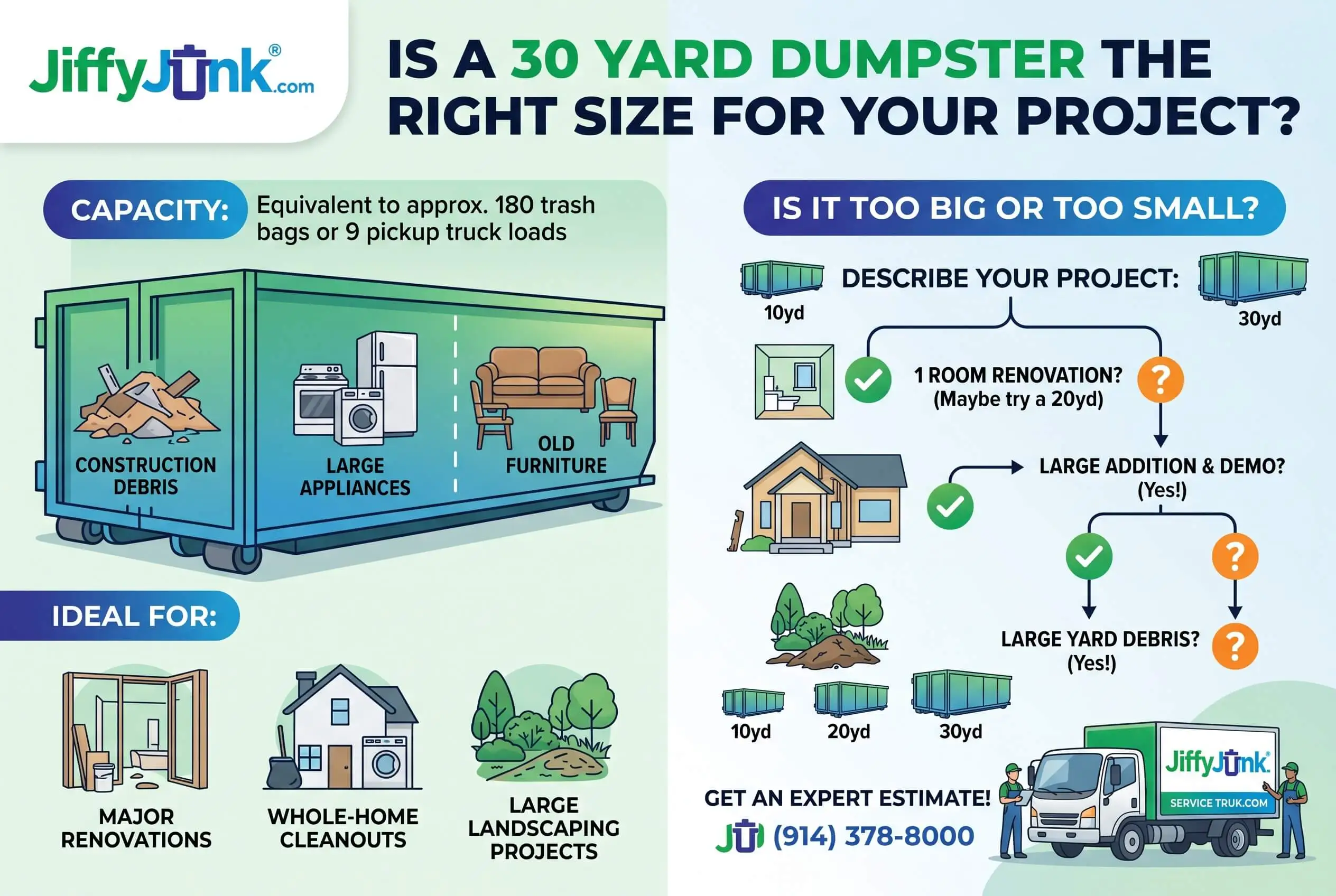
A 30 yard dumpster measures 22 feet long, 8 feet wide, and 6 feet tall, with a 30 cubic yard volume that holds about nine pickup truck loads of debris. Most haulers cap the load at 4 to 6 tons (8,000 to 12,000 pounds), and a 7-day rental runs $450 to $700 nationally. It's the right size for whole-house cleanouts, multi-room renovations, and residential roof replacements up to roughly 3,500 square feet.
At a glance:
Length: 22 ft
Width: 8 ft
Sidewall height: 6 ft
Volume: 30 cubic yards (≈ 9 pickup truck loads, or 170 to 190 standard 13-gallon trash bags)
Weight cap: 4 to 6 tons
Typical 7-day rental: $450 to $700
Best for: whole-house cleanouts, multi-room renovations, roof tear-offs
Quick tip from Jesse: Volume gets the headlines, but weight is what controls your final bill. A 30 yard load with shingles or concrete hits the tonnage cap long before the box looks full. Mix heavy material on the floor with lighter debris on top to use the full capacity without triggering an overage fee.
Top Takeaways
Know the dimensions before delivery. 22 feet long by 8 feet wide by 6 feet tall, with at least 25 feet of flat clearance and overhead space free of branches and power lines.
Weight matters more than volume. A half-full container of shingles or concrete can already be over its 4 to 6 ton allowance. Confirm tonnage with your hauler before you book.
When in doubt, size up. The price gap between a 20 and 30 yard is almost always smaller than the cost of a second haul.
Donate before you dump. Furniture, appliances, and building materials in usable condition belong at Habitat ReStore, not in a landfill. Diverting them lowers your container fill.
Get the all-in price. Base quotes leave out overage fees, daily extensions, and special-disposal charges. Ask for the total cost up front.
Refrigerants, hazardous waste, and tires stay out. These items are restricted everywhere and trigger fees or returns at the landfill.
What Is a 30 Yard Dumpster?
A 30 yard dumpster (also called a 30 cubic yard roll-off dumpster) is an open-top waste container designed to roll off the back of a flatbed truck and load on-site. The “30 yard” refers to volume capacity in cubic yards, not its physical length. Roll-offs were standardized in the mid-20th century and remain the dominant format for construction debris, large residential cleanouts, and renovation work.
Don't confuse roll-offs with the front-load and rear-load dumpsters you see behind restaurants and apartment complexes. Those are permanent fixtures emptied on a service route. Roll-offs are temporary. Delivered for your project, picked up when you're done.
Exact Dimensions and Driveway Requirements
A standard 30 yard dumpster measures roughly:
Length: 22 feet
Width: 8 feet
Sidewall height: 6 feet
Dimensions vary slightly between haulers, but most fall within a foot of those measurements. For placement, you need a flat hard surface at least 25 feet long and 10 feet wide, plus approach space for the truck.
The single most common delivery snag isn't the footprint on the ground. It's overhead. Tree branches, low utility lines, and porte-cochères catch drivers off guard every week. Walk the route from the street to the drop point before you book, and look up.
That 6-foot sidewall is also worth flagging. Once a 30 yard fills past halfway, you stop walking debris in through the back gate and start hoisting it up and over the wall. Plan your loading order accordingly. Heavy and awkward items first, while you can still walk them in.
How Much Can You Actually Fit Inside a 30 Yard Dumpster?
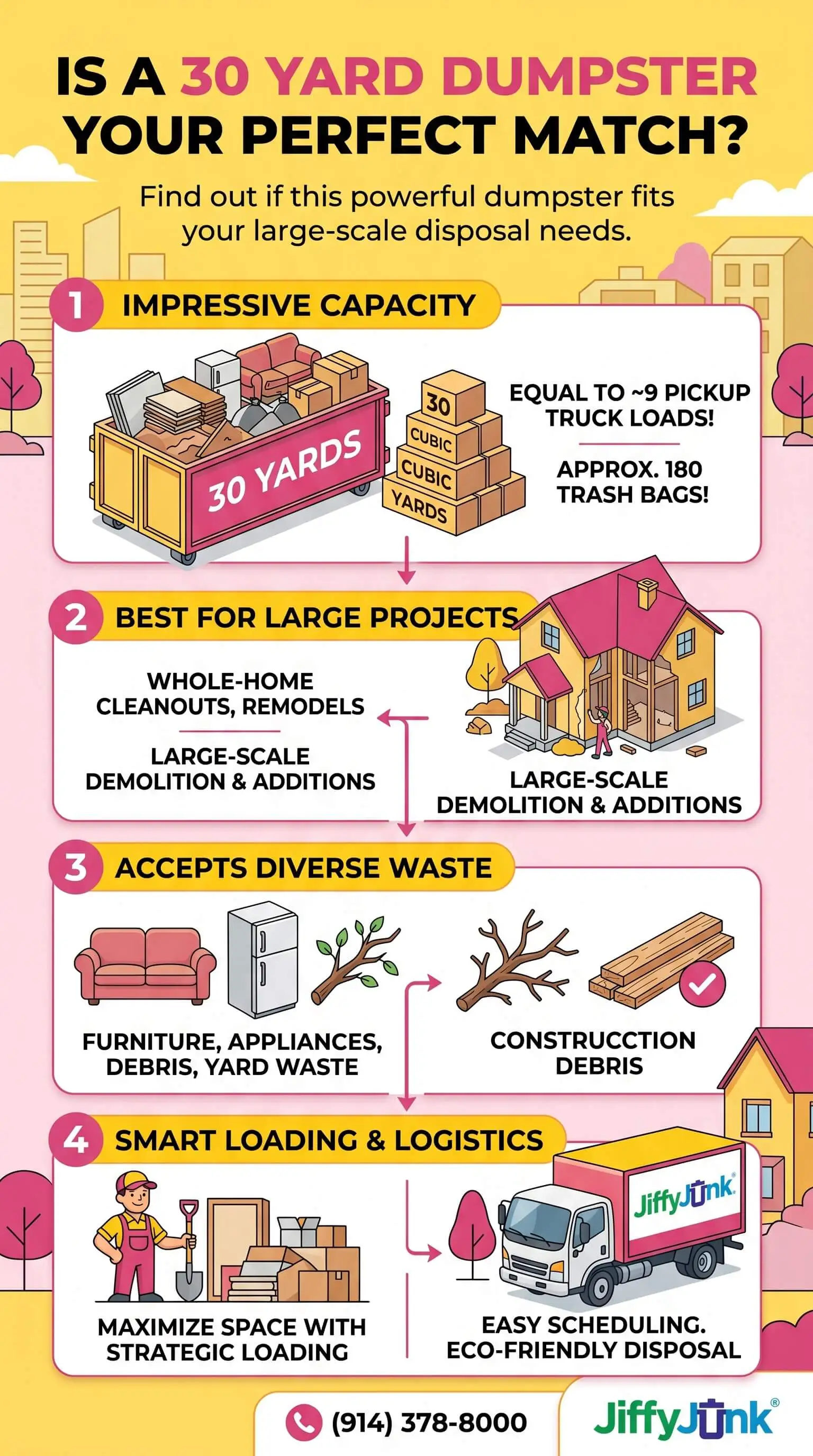
Thirty cubic yards is roughly nine full-size pickup truck loads, or 170 to 190 standard 13-gallon trash bags. That's the volume in a vacuum. Practical capacity depends on what you're loading.
Bulky, irregular items like couches, mattresses, and appliances burn space fast because of air pockets between pieces. Dense materials like concrete, dirt, and roofing shingles do the opposite. They hit the weight cap long before they fill the volume.
Here's what a 30 yard typically swallows in a single load:
Contents of a 3,000 to 5,000 square foot home cleanout
Debris from a 500 to 700 square foot roof replacement
Materials from a major kitchen and bathroom remodel
A full garage, basement, and attic emptied in one haul
Office furniture and equipment from a mid-size commercial space
For a side-by-side breakdown of how dimensions, capacity, and rental cost compare across project types, this 30 yard dumpster size and dimensions guide walks through each scenario with weight and volume numbers from a national hauler's actual job logs.
Weight Limits, and Why They Matter More Than Volume
Most 30 yard dumpsters allow between 4 and 6 tons of material (8,000 to 12,000 pounds), depending on the hauler and local landfill rules. This is the number that catches more renters off guard than any other.
Approximate weights by material, per cubic yard:
Household furniture and general items: 150 to 300 lbs
Mixed construction debris: 300 to 500 lbs
Roofing shingles: 750 to 1,000 lbs
Concrete and masonry: 2,000 lbs and up
Run the math on a half-loaded container of shingles and you'll see why customers get blindsided. A box that looks two-thirds empty can already be over its tonnage allowance. The fix is straightforward: load heavy material across the floor first, lighter items on top, and ask your hauler about the weight cap before you book, not after.
How Much Does a 30 Yard Dumpster Cost?
Nationally, expect to pay $450 to $700 for a 7-day rental. Costs swing based on geography, including tonnage, and how long you keep the container.
What's typically built into the base price:
Delivery and pickup
Standard rental window (usually 7 to 14 days)
Included tonnage (most rentals bundle 2 to 4 tons of disposal weight)
What costs extra:
Tonnage overages: $40 to $75 per additional ton
Daily extension fees: $10 to $25 per day past the rental window
Special disposal: appliances with refrigerants, mattresses (in some states), and electronics often carry separate handling fees
My standing advice: dumpster rental prices are easiest to compare when you look beyond the base quote and focus on the full value included in the final invoice. Ask for the all-in number that includes delivery, pickup, disposal, and your weight allowance, then compare across haulers with confidence. Urban and coastal markets price at the high end of the range. Rural and Midwest markets sit closer to the floor.
30 Yard vs. 20 Yard vs. 40 Yard. How to Pick.
When customers call unsure of size, I run them through three questions:
1. What's the project scope? Single-room remodel or small bath redo, 10 or 20 yards. Whole-house cleanout, multi-room renovation, or roof tear-off, a 30 yard. Full structural teardown or major commercial demo, a 40 yard.
2. What materials are you disposing of? Heavy material like concrete, brick, or roofing tile may justify a smaller container with a higher tonnage allowance. Lighter mixed debris is where the 30 yard's volume earns its keep.
3. What's your timeline? Long projects spread over weekends often justify the bigger container's extended rental window. Paying once for a 30 yard usually beats two hauls of a 20.
When the price gap between sizes is modest, and it usually is, size up. A second haul almost always costs more than the upgrade. Running out of room mid-project on day three of a renovation is the kind of headache nobody wants.
What You Can and Can't Throw In
Most cleanout and renovation materials go in without issue: furniture, drywall, flooring, cabinetry, fixtures, lumber, yard waste, asphalt shingles, and general household debris.
What stays out (rules vary by jurisdiction and hauler, but the pattern is consistent):
Hazardous waste, including paints, solvents, oil, chemicals, and pool chemicals
Batteries (automotive, lithium-ion, household)
Tires
Refrigerators, freezers, and AC units containing refrigerants. These require EPA-compliant handling under Section 608.
Flammable or explosive materials, including propane tanks
Electronics in many states (e-waste laws vary)
Asbestos-containing material. Always handled by licensed abatement contractors.
Most of these get caught at the landfill scale and either trigger an extra fee or get returned to you. A two-minute call with your hauler before loading saves the surprise.
“Here's the pattern I see on repeat. People fixate on volume (the 20, 30, 40 number) and forget the weight cap is what actually controls what they can throw away. I've watched a half-empty 30 yard get red-tagged for an overage because it was loaded with shingles. I've watched a stuffed-to-the-brim container roll out under-weight because it was furniture and drywall. Pick your size based on what the load is made of, not just how big the pile looks. And when you're honestly torn between two sizes, go bigger. The math on a second haul never works in your favor.”
7 Essential Resources
Before you load a single item, these are the trusted sources I send people to. They cover what's accepted, what's restricted, and how to keep usable material out of the landfill.
1. EPA Sustainable Management of Construction & Demolition Materials
The federal authority on what counts as C&D debris, what can be recycled, and how it should be managed. Worth a read before any renovation or teardown so you understand which of your materials have a “next use” rather than a landfill destination.
Best for: Renovations, demolition projects, mixed construction debris.
Source: U.S. Environmental Protection Agency
2. EPA Section 608. Disposal of Appliances Containing Refrigerants
Federal law on how refrigerators, freezers, window AC units, and dehumidifiers must be handled at end-of-life. The refrigerants inside have to be recovered by a Section 608-certified technician before the appliance can be disposed of. This is non-optional, and the fines for skipping it land on the property owner.
Best for: Refrigerators, freezers, window AC units, dehumidifiers.
Source: U.S. Environmental Protection Agency
3. EPA Hazardous Waste Basics
Plain-English overview of what counts as household hazardous waste and why it can't go in a standard roll-off. Paints, solvents, batteries, and certain cleaning chemicals all live here. Most municipalities run free hazardous waste drop-off days. Worth Googling before you start a project.
Best for: Paints, solvents, chemicals, batteries, fluorescent bulbs.
Source: U.S. Environmental Protection Agency
4. Earth911 Recycling Locator
Searchable database of more than 100,000 recycling locations across North America. Plug in your ZIP code and the material (electronics, scrap metal, tires, mattresses, fluorescent tubes), and it returns nearby drop-off points. The fastest way to keep recyclables out of your dumpster.
Best for: Electronics, scrap metal, tires, specialty recyclables.
Source: Earth911
5. Habitat for Humanity ReStore
Habitat ReStores accept gently used furniture, working appliances, cabinets, doors, and building materials. Most locations offer free pickup for larger donations. Anything you can divert here lowers the volume going into your dumpster and helps a local affordable-housing project at the same time.
Best for: Furniture, working appliances, cabinets, doors, fixtures.
Source: Habitat for Humanity
6. Solid Waste Association of North America (SWANA)
Professional trade association for waste management. SWANA's resource library is more technical than consumer-facing. It's the right place to go if you're managing a commercial cleanout, running a large-scale property clearing, or trying to verify standards for a contractor.
Best for: Commercial projects, contractor verification, technical disposal standards.
Source: Solid Waste Association of North America
7. Construction & Demolition Recycling Association (CDRA)
Trade group representing C&D processors and recyclers nationwide. CDRA maintains a member directory you can use to find processing facilities near you that handle clean concrete, asphalt, wood, drywall, and shingles. Tipping fees are often lower than landfills.
Best for: Concrete, asphalt, wood, drywall, asphalt shingles.
Source: Construction & Demolition Recycling Association
These essential resources help readers understand accepted, restricted, recyclable, and donation-ready materials before booking, so they can reduce landfill waste, avoid disposal issues, and better manage the cost to rent a small dumpster for cleanouts, renovations, and debris removal projects.
3 Statistics
Federal data confirms what we see in driveways and on job sites every week. Three figures put the scale of disposal, and the case for sizing your container correctly, in perspective.
1. 600 Million Tons of C&D Debris Generated Annually
The EPA estimates the United States generates roughly 600 million tons of construction and demolition debris each year. That's more than twice the volume of all municipal solid waste combined. Demolition alone accounts for over 90 percent of that figure. Of the total, about 76 percent is recovered or recycled rather than landfilled, with concrete, asphalt, and metals leading recovery rates.
What it means for your project: Whole-home renovations and teardowns generate far more debris than most homeowners expect. It's the single biggest reason the 30 yard makes sense for projects with multiple rooms or full structural work.
Source: EPA. Sustainable Management of Construction and Demolition Materials
2. 12.1 Million Tons of Furniture Discarded Each Year
Americans threw away 12.1 million tons of furniture and furnishings in 2018, about 4.1 percent of all municipal solid waste. Roughly 80 percent of it ended up in landfills, with a recycling rate under 1 percent. A single estate or whole-house cleanout can fill a 30 yard with sofas, dressers, mattresses, and dining sets, much of it still functional.
What it means for your project: Before you fill the container, walk through what's actually broken versus what's just unwanted. Habitat ReStore and similar donation channels can absorb a meaningful fraction of a typical cleanout.
Source: EPA. Durable Goods: Product-Specific Data
3. Major Appliances Recycled at a 60% Rate
The EPA reports approximately 60 percent of major appliances reaching end-of-life are recycled, among the highest recovery rates of any durable good category. The steel, copper, and aluminum inside a typical refrigerator have real scrap value, which is part of why these units get pulled out of dumpsters by landfill operators rather than buried.
What it means for your project: Refrigerators, freezers, and AC units containing refrigerants can't legally go in a standard roll-off without prior treatment. Plan for separate handling, or coordinate with a hauler that offers compliant appliance pickup.
Source: EPA. Durable Goods: Product-Specific Data
Final Thoughts and Opinion
Here's where I've landed on the 30 yard question after enough projects to lose count.
It's the workhorse size. Not the most economical for a single bathroom remodel, not the right call for a structural teardown, but the right one for the broad middle of homeowner and small commercial work. That's where mixed debris adds up faster than expected and a second haul costs more than upgrading once.
My honest take is that most renters under-estimate volume and over-estimate weight. The visible pile in a garage or attic looks bigger than it is once compressed into a roll-off. The heavy stuff (shingles, tile, concrete chunks) sneaks up on the tonnage allowance fast. If your project skews heavy, talk to your hauler about a smaller container with a beefier weight allowance instead of defaulting to the next size up.
Before you book anything, take 30 minutes to separate. Donate what's still usable. Pull aside the hazardous items and electronics, including anything left over from a professional pest control service. Recycle the metals. You'll need less containers, you'll pay less in disposal fees, and you'll keep usable material out of the waste stream. For the deeper numbers on dimensions, weight, and rental cost factors I don't have room to walk through here, this complete 30 cubic yard dumpster guide is the most thorough breakdown I've seen.
Frequently Asked Questions
Q: What are the exact dimensions of a 30 yard dumpster?
A standard 30 yard dumpster is roughly 22 feet long, 8 feet wide, and 6 feet tall. Dimensions vary by hauler, but most fall within a foot of those measurements. Plan for at least 25 feet of flat driveway and overhead clearance for delivery.
Q: How much weight can a 30 yard dumpster hold?
Most 30 yard dumpsters allow 4 to 6 tons (8,000 to 12,000 pounds) of material. The exact cap depends on the hauler and local landfill rules. Heavy materials like concrete and roofing shingles can max out the weight allowance well before the container is visually full.
Q: How much does it cost to rent a 30 yard dumpster?
National pricing for a 7-day rental typically runs $450 to $700, including delivery, pickup, and a baseline tonnage allowance. Urban markets price at the high end. Always ask for the all-in cost. Overage fees ($40 to $75 per ton) and daily extensions ($10 to $25 per day) are common surprise charges.
Q: What can’t I put in a 30 yard dumpster?
Hazardous waste, batteries, tires, flammable liquids, propane tanks, and appliances containing refrigerants (refrigerators, freezers, AC units) are universally restricted. Electronics and asbestos-containing material are restricted in most states. Confirm with your hauler before loading.
Q: Is a 30 yard dumpster too big for a single-room remodel?
Almost always, yes. A single bathroom or bedroom remodel typically generates 4 to 8 cubic yards of debris, well within the range of a 10 or 20 yard container. Save the 30 yard for whole-house cleanouts, multi-room renovations, or roof tear-offs.
Q: How many pickup truck loads does a 30 yard dumpster hold?
About nine full-size pickup truck loads, or 170 to 190 standard 13-gallon trash bags. Practical capacity varies based on what you're loading. Bulky furniture fills volume faster, dense material like concrete fills weight first.
Ready to Book the Right Size?
If your project matches what we covered (whole-house cleanout, multi-room renovation, roof tear-off, full garage and basement), the 30 yard is your size. Four steps before you book:
Measure your driveway and check overhead clearance
Set aside donatable furniture, appliances, and building materials
Pull hazardous items, batteries, electronics, and refrigerant-containing appliances for separate handling
Get an all-in price from at least two haulers, including tonnage allowance and overage rates
Take those four steps and the rental itself becomes the easy part. Got a question about your specific project? Tap through to our complete dumpster sizing and rental cost guide for the full breakdown, or leave a comment below and I'll respond personally.