I see homeowners pay double the fair price every week. It almost always traces back to the same problem: nobody walked them through which line items on a removal quote are real and which are filler. So here is the walk-through.
Per square foot, the national range for carpet removal services costs $1.00 to $5.00 depending on installation method. Stretch-in lives at the bottom of that range. Glued-down lives at the top. Where your specific job lands is mostly a function of two things: what is under the carpet, and how much furniture the crew has to move first.
Wall-to-wall carpet has been a default living room finish in American homes since the late 1940s, and most of what I see pulled up in 2026 was last replaced sometime between 2005 and 2015. If yours falls in that window, the timing checks out. Manufacturers recommend replacement within ten years. After that, the fibers stop bouncing back where the foot traffic lives.
Below I will break down what actually drives your final number, when DIY saves real money and when it costs you more, how to pressure-test a quote before signing, and the seven outside resources I send homeowners to when they want to verify what a fair looks like in their zip code.
TL;DR Quick Answers
Carpet Removal Services Cost
Professional carpet removal services cost $1.00 to $5.00 per square foot in 2026, or roughly $300 to $600 for a standard 200 to 300 square foot living room with disposal handled. Stretched-in carpet sits at the bottom of that range. Glued-down carpet sits at the top because crews have to scrape adhesive off the subfloor before the next flooring goes in.
Quick price reference by room size:
Small room (120–180 sq ft): $170–$360
Standard living room (200–300 sq ft): $300–$600
Large living room (300–500 sq ft): $500–$1,000
Open-concept or great room (500+ sq ft): $900–$1,800+
DIY saves $200 to $400, but the math only works if your carpet is stretched-in (not glued), you can haul it to a landfill yourself, and you do not mind four to eight hours of physical work.
The most common reason homeowners overpay: they accept a verbal quote without confirming whether it includes the pad, tack strips, furniture moving, and disposal. Always get the line-itemized breakdown in writing.
Top Takeaways
Standard living room carpet removal cost in 2026: $300 to $600 for a 200 to 300 sq ft room with a professional crew.
Per square foot range: $1.00 to $5.00, depending on installation method.
Glued-down carpet costs roughly 3x more to remove than stretched-in carpet because of the adhesive scraping labor.
Always confirm in writing whether your quote includes padding, tack strips, furniture moving, and disposal.
DIY saves $200 to $400 but only makes financial sense for stretch-in carpet, small rooms, or if you already have hauling capacity.
Pre-1980s homes may have asbestos in the underlay. Test or hire a professional.
Get three line-itemized quotes before booking. The cheapest verbal estimate is rarely the cheapest final invoice.
How Much Does Living Room Carpet Removal Cost in 2026?
Three buckets, depending on how the carpet was installed and what shape the subfloor is in. Here is what I am seeing on the ground this year.
Small living room (120–180 sq ft): $60–$110 DIY (disposal only) or $170–$360 with a professional crew.
Standard living room (200–300 sq ft): $100–$180 DIY or $300–$600 with a professional crew.
Large living room (300–500 sq ft): $150–$300 DIY or $500–$1,000 with a professional crew.
Open-concept or great room (500+ sq ft): $250–$500 DIY or $900–$1,800+ with a professional crew.
What Actually Drives the Price
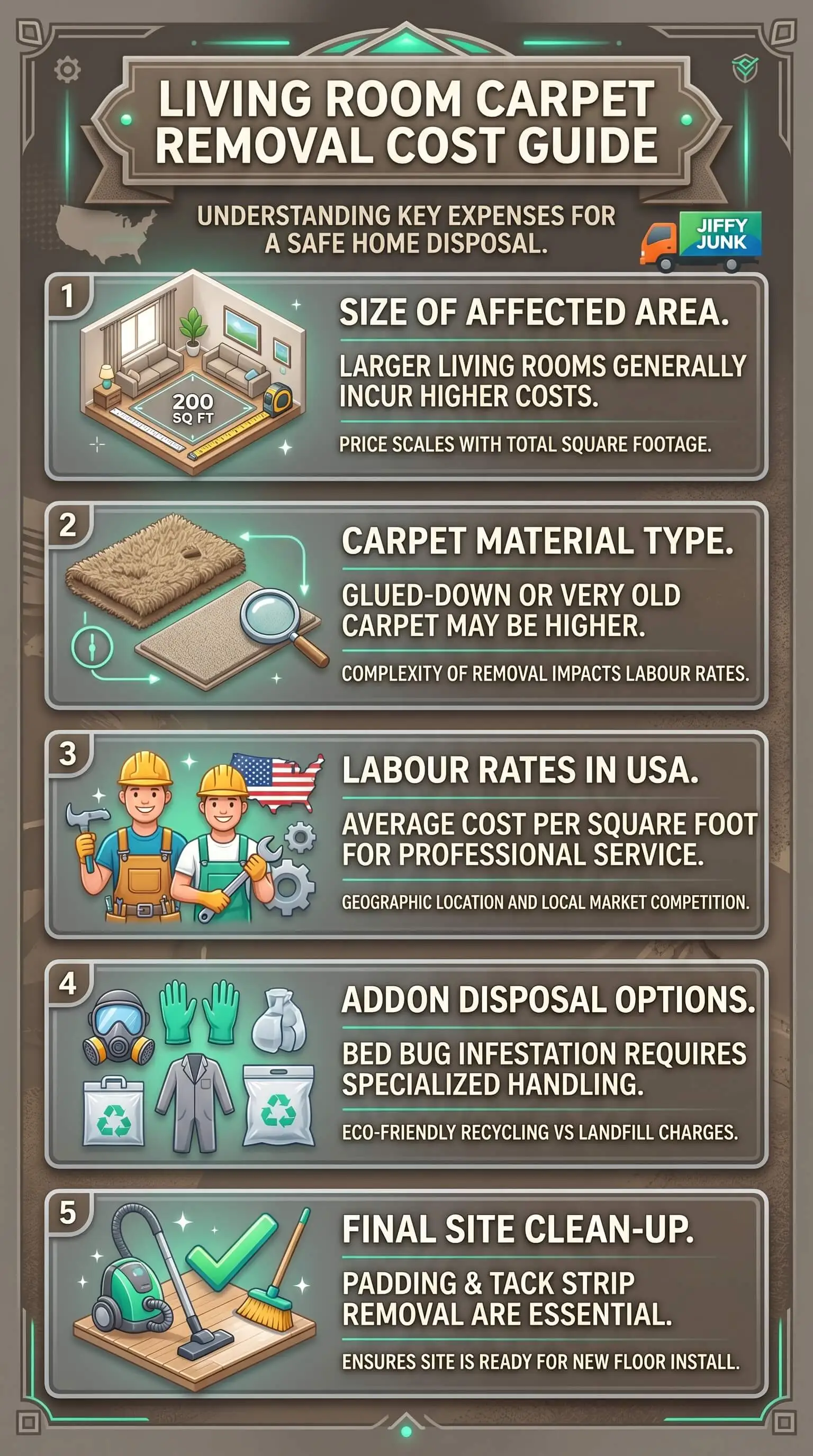
After watching hundreds of removal jobs, I can tell you the seven variables that move your invoice up or down faster than anything else. Here they are in rough order of impact.
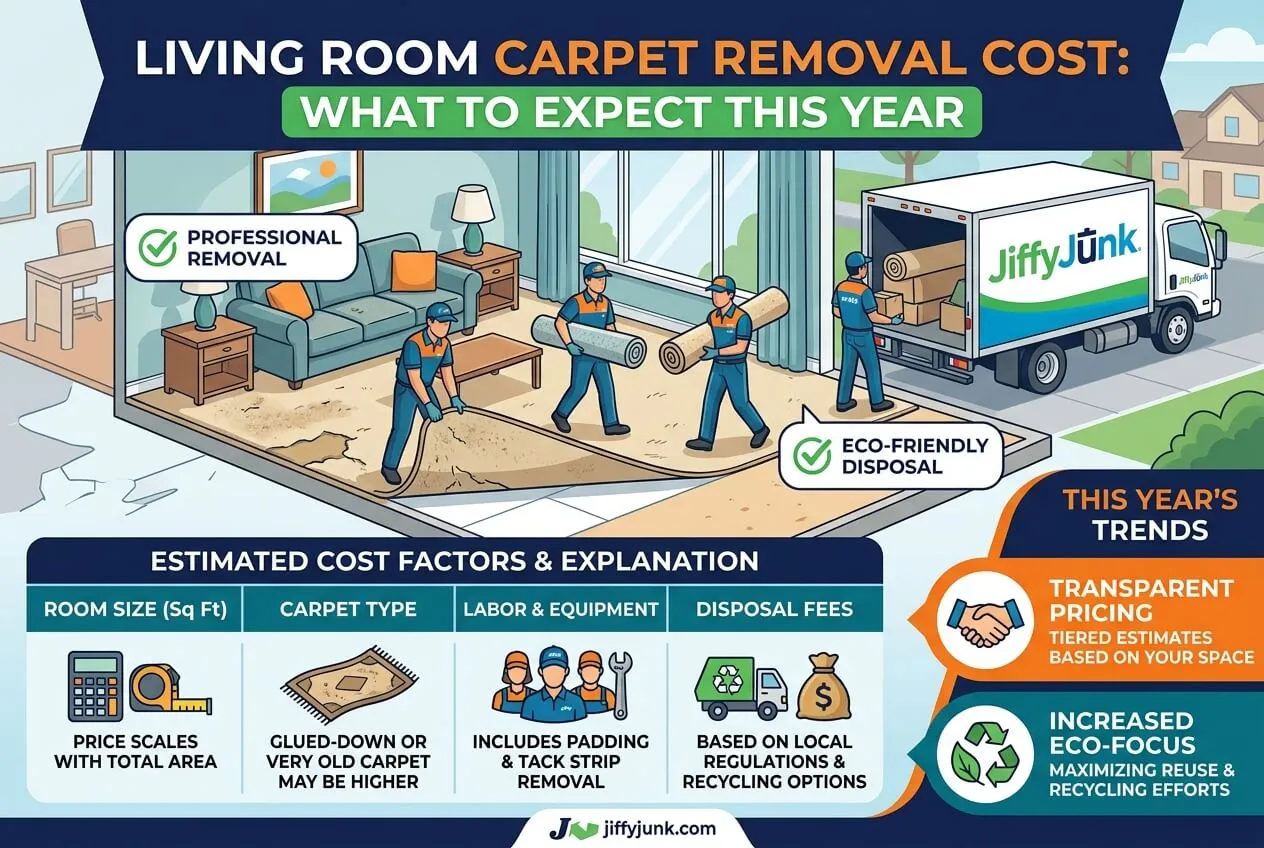
Square footage. Most pros bid per square foot, then add minimums. A 120 sq ft den might be quoted the same as a 180 sq ft room because crews have a baseline truck-roll fee.
Installation method. Stretched-in carpet (tack strips around the edges) runs $0.50 to $1.50 per square foot to pull. Glued-down jumps to $3.00 to $5.00 per square foot because crews have to scrape adhesive off the subfloor.
Padding and tack strips. Some quotes cover only the carpet itself. If you are putting in new flooring, you want the pad and strips out too. The strips alone run $0.40 to $0.50 per linear foot.
Subfloor condition. Old glue residue, water damage, or rotting plywood adds time. Subfloor repair runs $2.20 to $4.75 per square foot if you need it.
Furniture moving. An empty room means a 60 to 90 minute job. A fully furnished living room can add 30 to 60 minutes of labor and sometimes a $50 to $100 furniture-handling fee.
Disposal and haul-away. Landfill tipping fees swing wildly by region. Carpet disposal alone runs $0.40 to $0.60 per square foot, or $50 to $100 flat for an average load. Some companies absorb the fee. Others pass it through.
Geographic location. Labor rates in San Francisco, New York, and Boston run 30 to 50 percent above the national average. Rural Southeast and Midwest jobs come in under.
DIY vs. Hiring a Professional
Pulling up your own carpet sounds simple until you are halfway through, exhausted, sneezing on a decade of trapped allergens, and trying to figure out how to fit a 200-pound rolled carpet into a sedan. The DIY math is real. You can save $200 to $400 on a standard living room. But that math only works if three things are true: you have a way to haul the carpet to a landfill, you do not mind four to eight hours of physical work, and the carpet is stretch-in (not glued).
If your home was built before 1980, there is one more reason to slow down. Some pre-1980s carpet padding contained asbestos fibers from recycled hessian bags, and disturbing that material can release particles into the air. I tell every homeowner in an older house the same thing: get the underlay tested before you cut, or hire a professional who knows what to look for, just as you would rely on professional pest control services when hidden household hazards need trained identification and safe handling.
How to Get an Accurate Carpet Removal Quote
Before you call anyone, give yourself fifteen minutes for this prep:
Measure your living room. Length × width = square footage. Add ten percent for closets or alcoves.
Check the carpet type and approximate age. Lift a corner near a doorway if you can.
Figure out whether it is stretched, stapled, or glued. Glued is the heaviest cost driver of the three.
Decide whether you want padding and tack strips removed too.
Get three written quotes that itemize labor, disposal, and any add-ons separately.
When you compare quotes, the line item homeowners miss most often is disposal. For homeowners who want to compare line items before booking, this professional carpet removal services cost breakdown from Jiffy Junk lays out residential and commercial pricing side by side, including the haul-away fees that a lot of quotes hide in the fine print. Reading through a transparent breakdown like that makes it much easier to spot when a local quote is stuffed with vague “disposal handling” charges.
“The single biggest mistake I watch homeowners make on a living room carpet removal is pricing the job by the carpet alone. The carpet is the visible part. The invoice tracks what is underneath: padding weight, staples, tack strips, and whether the original installer used glue. I have walked into 250 square foot living rooms where the visible carpet looked simple, but the previous owner had glued it down to fix a wrinkle and the removal cost tripled. Always ask the contractor to confirm in writing whether the price is for carpet only, carpet plus pad, or full tear-out down to a clean subfloor. That one question saves homeowners more money than any other piece of advice I give.”
7 Essential Resources
I do not expect anyone to take a single article at face value, including this one. These are the seven sources I personally cross-check pricing, recycling options, and safety guidance against before I recommend anything to a homeowner. Bookmark them.
1. Angi — How Much Does Carpet Removal Cost?
https://www.angi.com/articles/how-much-does-carpet-removal-cost.htm
Angi pulls real homeowner-reported project costs from across the country. It is the most useful single source for sanity-checking a quote against the national average ($1 to $5 per square foot, $280 average per project).
2. HomeAdvisor — Carpet Removal Cost Calculator
https://www.homeadvisor.com/cost/flooring/carpet-removal/
Plug in your zip code and project size, and HomeAdvisor returns a localized estimate. Their range of $1.10 to $5.10 per square foot reflects regional labor variation more accurately than a flat national figure.
3. HomeGuide — Carpet Removal Cost Breakdown
https://homeguide.com/costs/carpet-removal-cost
Strong on granular itemization, including stair-removal pricing ($7 to $10 per stair), basement adjustments, and disposal-only rates. Useful when your project mixes living rooms with adjacent rooms.
4. Homewyse — 2026 Carpet Removal Cost Calculator
https://www.homewyse.com/services/cost_to_remove_carpet.html
Updated to January 2026 figures. Homewyse separates labor, materials, and contractor markup so you can see exactly what is going into a bid.
5. EPA — Durable Goods (Carpet & Rugs) Material Data
The federal data source for how much carpet ends up in landfills versus recycling. Worth reading if you are weighing whether to pay extra for a recycling drop-off.
6. Carpet America Recovery Effort (CARE)
CARE maintains a national database of carpet recyclers and runs the only U.S. extended producer responsibility program for carpet (in California). If you want to keep your old carpet out of a landfill, this is the starting point.
7. Jiffy Junk — Carpet Removal Service Cost Guide
A transparent breakdown of residential and commercial rug disposal pricing from a national junk-removal operator. Good benchmark for what “all-in” pricing (removal + haul + disposal) actually looks like when nothing is hidden.
3 Statistics
Numbers cut through marketing language faster than anything. These three figures shaped the way I think about carpet removal, and they should shape yours too.
Statistic 1: 73% of all carpet thrown out in the U.S. ends up in a landfill.
The EPA estimates that 3.4 million tons of carpets and rugs entered the U.S. municipal solid waste stream in 2018, and roughly 73 percent of that volume went straight to a landfill. Recyclers processed only 9.2 percent. That ratio is one of the reasons I push homeowners to ask their removal contractor what happens to the old carpet after it leaves the truck. Source: U.S. EPA — Durable Goods: Carpet & Rugs Data.
Statistic 2: California hit a record 38.5% carpet recycling rate in 2024.
California is the only U.S. state with a mandatory carpet stewardship program, and the result speaks for itself. The Carpet America Recovery Effort reported that California collection sites took in 82.7 million pounds of carpet in 2024, and 90.5 percent of that volume was recycled. That is an all-time high. If you live in California, recycling is genuinely accessible at 390+ collection points statewide. Outside California, you will need to use the CARE database to find your closest recycler. Source: Carpet America Recovery Effort — 2024 California Annual Report.
Statistic 3: Construction and demolition debris in the U.S. exceeds 600 million tons annually.
Carpet removal sits inside a much larger waste category. The EPA estimates that 600 million tons of construction and demolition debris ran through U.S. waste streams in 2018, more than twice the volume of all municipal solid waste combined. The reason this matters for your living room project: tipping fees and landfill capacity directly affect what your removal contractor charges. In regions where landfill space is tight, expect disposal line items to run higher. Source: U.S. EPA — Construction and Demolition Debris Material-Specific Data.
Final Thoughts and Opinion
Here is the honest take.
For a standard 200 to 300 square foot living room with stretched-in carpet, professional removal is almost always worth the $300 to $600. You skip a half-day of physical labor, you skip the trip to the landfill, and you skip the back strain that comes with rolling and dragging old carpet. The DIY savings are real (around $200 to $300), but the time and physical cost rarely pencil out unless you genuinely enjoy the work.
DIY makes more sense in two cases. Very small rooms (under 150 square feet) where the labor is short, and homes where you already own a truck and a dump pass. Outside those scenarios, hire it out.
Where I see homeowners get burned most often is the gap between the verbal quote and the final invoice. “We will take care of disposal” is doing a lot of work in that sentence. Sometimes it means flat-rate haul-away. Sometimes it means a per-pound landfill pass-through that adds $100 you did not budget for. Always get the quote in writing, line-itemized. That single document is the difference between a smooth project and a frustrating one.
If your home was built before 1980, my opinion shifts harder toward hiring a professional. The asbestos risk in older padding is statistically low but real, and the cost of a licensed pro who knows how to handle it is far cheaper than the cost of cleaning up airborne fibers in your home.
One last opinion that may not be popular: do not pay extra for “recycling” unless you can verify where the carpet is actually going. The national recycling rate for carpet is under 10 percent. Outside California, most carpet picked up by general removal services ends up in a landfill regardless of what the marketing says. If recycling matters to you, drop the carpet at a CARE-listed recycler yourself, or ask your contractor for a chain-of-custody receipt, the same kind of proof you would want from a treadmill removal service when confirming whether bulky equipment is being donated, recycled, or hauled to disposal.
Frequently Asked Questions
How much does it cost to remove carpet from a living room?
For a standard 200 to 300 square foot living room, professional carpet removal costs between $300 and $600 in 2026. Smaller rooms come in at $170 to $360, and large open-concept spaces over 500 square feet can run $900 to $1,800. Per-square-foot pricing typically ranges from $1.00 to $5.00 depending on whether the carpet is stretched-in or glued down.
Is it cheaper to remove carpet yourself or hire a professional?
DIY is cheaper on paper. Typically $100 to $200 in disposal-only costs, versus $300 to $600 for a professional. The catch: you need a vehicle that can haul rolled carpet, access to a landfill or transfer station, the physical capacity for four to eight hours of labor, and the right tools (utility knife, pry bar, gloves, dust mask). For most homeowners with stretched-in carpet in a small-to-medium room, hiring out is worth the $200 to $400 difference.
Does carpet removal include the padding and tack strips?
Sometimes yes, sometimes no. Always confirm in writing. Many quotes cover only the carpet itself. Pad removal can add $0.20 to $0.50 per square foot, and tack strip removal runs $0.40 to $0.50 per linear foot. If you are installing new flooring, you almost always want both removed down to a clean subfloor.
How long does professional carpet removal take?
Most pros finish a 12-by-12 living room (about 144 square feet) in one to two hours. A standard 200 to 300 square foot room takes two to three hours including disposal. Glued-down carpet on concrete can extend that to four to six hours because of the adhesive scraping. Furniture-heavy rooms add 30 to 60 minutes.
Can old carpet be recycled instead of landfilled?
It can be, but the U.S. recycling rate for carpet is only 9.2 percent nationally. California has a stewardship program with hundreds of drop-off points and hits 38.5 percent recycling. Outside California, your best bet is to search the Carpet America Recovery Effort (CARE) database for the nearest recycler. Recycled carpet becomes new carpet, automotive components, building insulation, and erosion-control products.
Do I need to move furniture before the crew arrives?
Most companies will move furniture for an extra $50 to $100 flat fee, or sometimes free for empty rooms. Doing it yourself the day before saves time and money, and gives you a chance to declutter. If the furniture is going back into the room, plan where to stage it (garage, adjacent room, or covered patio).
What is the average carpet disposal cost at a landfill?
If you are hauling the carpet yourself, expect $0.40 to $0.60 per square foot in tipping fees, or $50 to $100 flat for an average-sized load. A junk removal service charges $80 to $160 for disposal-only pickup. Tipping fees vary by region. Densely populated areas with limited landfill capacity charge more.
Ready to Schedule Your Carpet Removal?
If you have read this far, you have a clear picture of what fair pricing looks like and what to ask before you book. The next step is the easy one. Measure your living room, snap a photo of the existing carpet (especially a corner where you can see how it is attached), and request quotes from two or three local providers.
If you want a same-week professional removal with transparent flat-rate pricing that includes disposal, take a look at the carpet removal services cost guide I referenced earlier. It is the cleanest pricing breakdown I have seen for residential and commercial rug disposal, and it doubles as a benchmark when you are comparing local quotes.