TL;DR Quick Answers
20 yard dumpster size
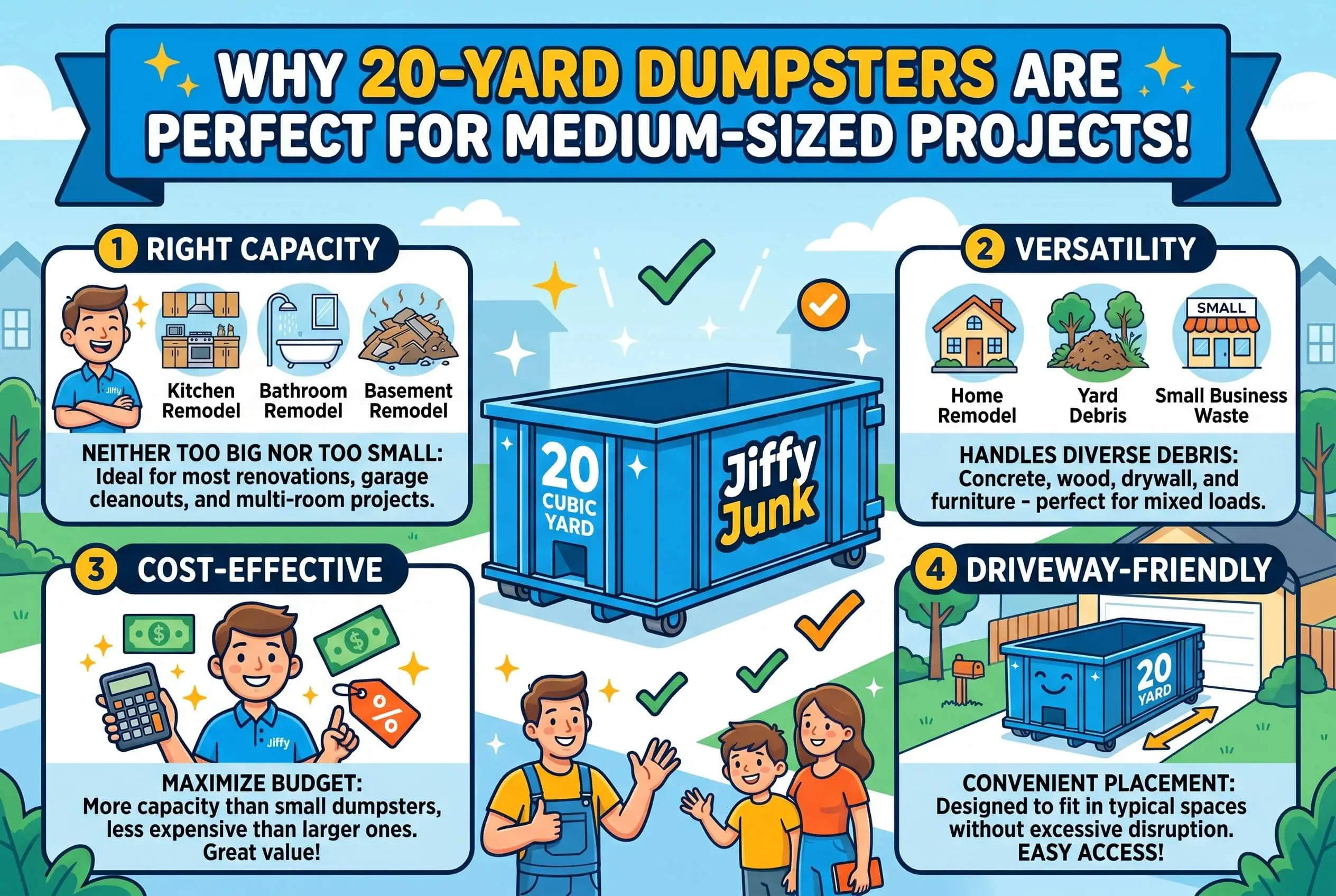
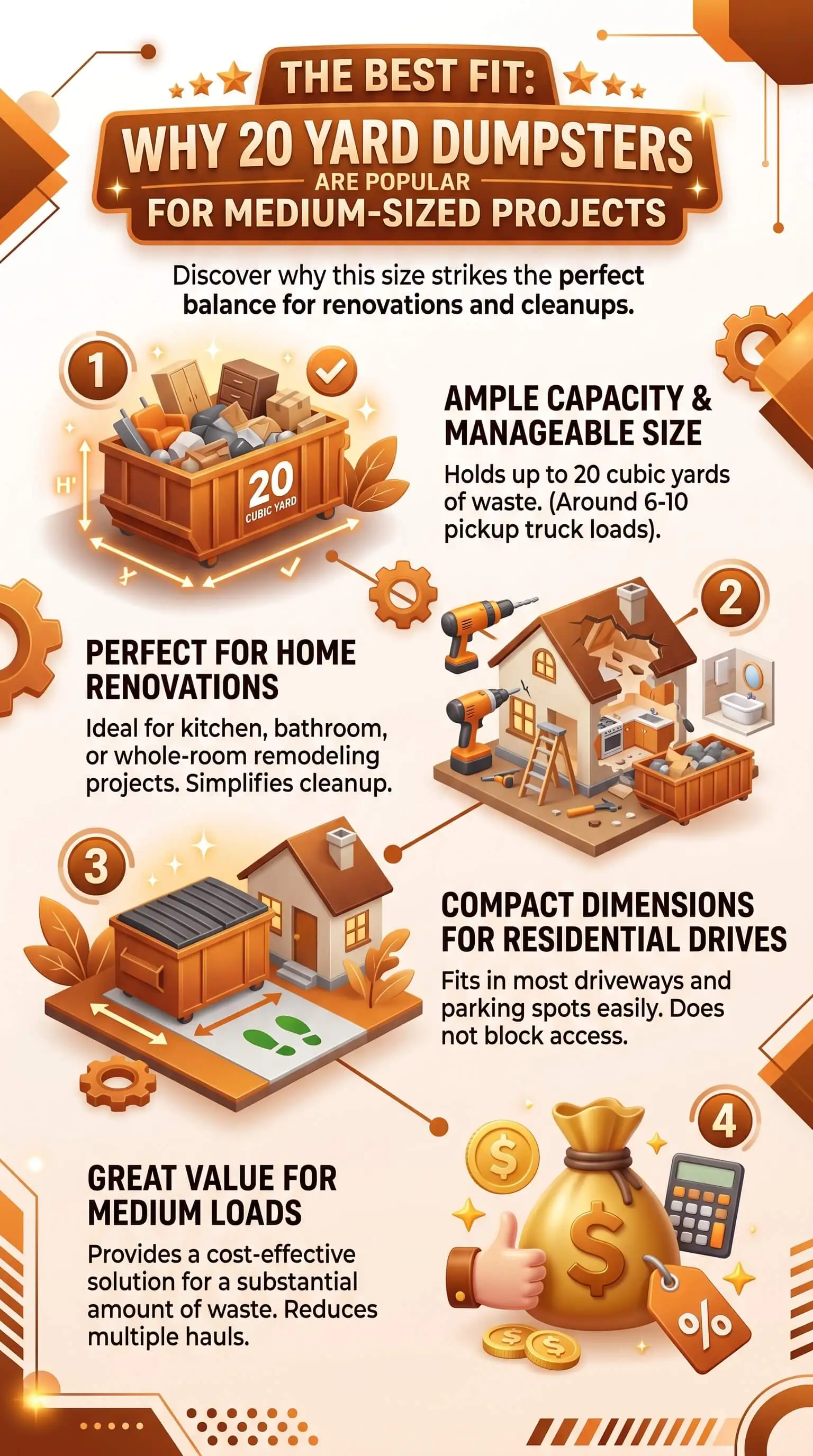
A 20 yard dumpster measures roughly 22 feet long × 8 feet wide × 4 to 4.5 feet high and holds 20 cubic yards of debris, about six pickup-truck loads or 110 to 130 standard 33-gallon trash bags.
Key specs at a glance:
Capacity: 20 cubic yards (~6 pickup-truck loads, 110–130 trash bags)
Weight cap: 2–3 tons (4,000–6,000 lbs)
Footprint: Fits a standard residential driveway
Rental cost: $300–$650 for a 7- to 10-day window
Best for: Mid-size kitchen and bath remodels, full garage or basement cleanouts, small-to-mid roof tear-offs, estate cleanouts for 2–3 bedroom homes
In my own work, this size handles roughly seven of every ten medium-sized residential projects, which makes it a smart value point for roll-off dumpster prices on typical home cleanouts and remodels. The biggest sizing trap homeowners hit is weight, not volume: dense materials like concrete and roofing shingles can max out the tonnage cap long before the container looks full.
Top Takeaways
A 20 yard dumpster is the default recommendation for medium-sized projects. That includes kitchen and bath remodels, full garage and basement cleanouts, roof tear-offs on small-to-mid homes, and most estate cleanouts for two-to-three-bedroom properties.
Typical dimensions are 22 ft × 8 ft × 4–4.5 ft, holding roughly six pickup-truck loads or 110 to 130 standard trash bags.
Weight matters more than volume for cost. A 2 to 3 ton cap fills fast with concrete, brick, or shingles. Plan by weight first, volume second.
Cost typically runs $300 to $650 for a 7 to 10 day rental, varying mostly by region, debris type, and weight overages.
The 20 yard size handles roughly 70% of mid-scale residential projects without forcing a sizing-up or sizing-down decision.
Donate and recycle before you load. A ReStore call or Earth911 search can divert hundreds of pounds and reduce both cost and environmental impact.
A 20 yard dumpster is a roll-off container that holds roughly 20 cubic yards of debris. That works out to about six full pickup-truck loads, or somewhere between 110 and 130 standard 33-gallon trash bags. Typical dimensions run 22 feet long, 8 feet wide, and 4 to 4.5 feet high, though specs vary by provider and region. The four-foot wall height matters more than people realize. It sits low enough for an average adult to toss debris over the edge without a ladder, which on a multi-day project is the difference between a job that gets done and one that drags.
The 20 yard size fits medium work because it lines up with the actual material output of common residential projects. A mid-size kitchen remodel produces eight to fifteen cubic yards of debris from cabinets, countertops, flooring, and drywall, depending on demolition scope. A full garage cleanout on a home that's been lived in for a decade or two usually lands in the same range. So does a roof tear-off on a single-layer asphalt-shingle home of 1,500 to 2,500 square feet. In each case, a 20 yarder absorbs the project without forcing you to pay for unused capacity, the way a 30 yarder often does for jobs of this scale. It also avoids the ceiling pressure of a 10 or 15 yarder, where you end up compressing, restacking, or scheduling a swap mid-project.
Cost is the other piece. Twenty yard rentals typically run $300 to $650 for a standard 7 to 10 day window. Regional landfill fees, debris type, and weight overages drive most of the variation. That price band is where the math tips in the homeowner's favor versus borrowing a truck for four or five round trips to a transfer station.
In my own work, I've watched the 20 yard size carry the day on full garage and basement cleanouts, mid-scope kitchen and bathroom remodels, roof tear-offs on small-to-mid homes, deck removals up to roughly 500 square feet, large yard and landscaping overhauls, and estate cleanouts for two-to-three-bedroom homes. If your project is on that list, the 20 yarder is the size to price first. For prep work, our guide on how to prepare for a junk removal service is a useful starting point, and if a garage cleanout is what's pushing you toward the rental, our walkthrough on starting a garage cleanout when you have no time covers the practical pre-staging steps.
The factor homeowners regularly underestimate is weight, not volume. A 20 yard container typically carries a 2 to 3 ton (4,000 to 6,000 lb) weight cap. That's plenty for furniture and household clutter. It hits the ceiling fast with concrete, brick, roofing tiles, or wet soil. I've watched homeowners fill a 20 yarder less than a third of the way with concrete debris and still trip the overage threshold. If your project is heavy on dense materials, the smarter call is often a smaller container with a higher relative weight allowance, or planning for two pulls. Jumping up a size doesn't solve a weight problem.
"The biggest mistake I see homeowners make on medium-sized projects is choosing based on how big the pile looks rather than how heavy the materials are. A 20 yard dumpster will swallow an entire garage's worth of stored junk and barely register the weight, but that same container loaded with shingles from a 2,000-square-foot roof tear-off can hit its tonnage cap before it's two-thirds full. After working alongside contractors and homeowners on cleanouts and remodels for years, my honest advice is simple. Scope your project by weight category first, then volume. That single reframe has saved every client I've shared it with from at least one surprise overage fee. The 20 yard size earns its popularity for medium projects because it genuinely is the right answer most of the time, as long as you size to the actual debris and not the driveway." — Jesse Bement
7 Essential Resources
The resources below are the references I send people to when they're scoping a mid-sized project and want to make informed decisions before they call a rental company. Each is a primary or industry-authoritative source.
1. Wikipedia — Dumpster Overview A solid plain-language reference for what roll-off dumpster containers are, how they evolved, and how they're categorized. Useful as a baseline before you turn to rental-specific resources. ???? https://en.wikipedia.org/wiki/Dumpster
2. U.S. EPA — Construction and Demolition Debris: Material-Specific Data The federal source of truth on C&D debris generation in the United States. If you want to understand the scale of the waste stream your remodel is contributing to, start here. ???? https://www.epa.gov/facts-and-figures-about-materials-waste-and-recycling/construction-and-demolition-debris-material
3. U.S. EPA — Sustainable Management of Construction and Demolition Materials EPA guidance on best practices for reducing, reusing, and recycling C&D materials. Genuinely useful if your project includes salvageable lumber, fixtures, or metals. ???? https://www.epa.gov/smm/sustainable-management-construction-and-demolition-materials
4. Joint Center for Housing Studies, Harvard University — Remodeling Futures Program The leading research program on the U.S. remodeling industry, including the quarterly Leading Indicator of Remodeling Activity (LIRA). Essential context for understanding how big this market actually is. ???? https://www.jchs.harvard.edu/research-areas/remodeling
5. Habitat for Humanity ReStore — Donate Goods Before anything goes in the dumpster, this is the call to make. ReStore locations accept furniture, appliances, cabinetry, and building materials in good condition, and many offer free pickup. Diverting usable items reduces both your dumpster load and your environmental footprint. ???? https://www.habitat.org/restores/donate-goods
6. Earth911 — Recycling Center Search The largest database for finding local recycling facilities for items that don't belong in a roll-off, including electronics, paint, batteries, and mattresses. Searchable by ZIP and material type. ???? https://search.earth911.com/
7. Jiffy Junk — How Big Is a 20 Cubic Yard Dumpster: Size, Dimensions, and Rental Cost One of the more thorough side-by-side guides I've come across on actual 20 cubic yard dumpster size, dimensions, and rental cost ranges. If you want a deeper operational breakdown from a service provider that handles these every day, this is worth bookmarking. ????
3 Statistics
1. The U.S. generated 600 million tons of construction and demolition debris in 2018, more than twice the volume of all municipal solid waste combined. Source: U.S. Environmental Protection Agency ???? https://www.epa.gov/facts-and-figures-about-materials-waste-and-recycling/construction-and-demolition-debris-material
This is the big-picture number that explains why dumpster rentals exist as an industry. Renovation and demolition produce a staggering amount of waste every year, and the 20 yard size is one of the workhorse containers absorbing the residential share of it.
2. The U.S. home remodeling market reached an estimated $509 billion in 2025, according to Harvard's Joint Center for Housing Studies. Source: Joint Center for Housing Studies of Harvard University, Leading Indicator of Remodeling Activity (LIRA) ???? https://www.jchs.harvard.edu/press-releases/modest-gains-2025-outlook-home-remodeling
A market this size means an enormous volume of mid-scale renovation projects every year. Kitchens, baths, additions, and full system replacements all generate the kind of debris a 20 yard dumpster is sized to handle.
3. Roofing tear-offs in the U.S. generate approximately 11 million tons of asphalt shingle waste annually, the bulk of it from residential projects. Source: U.S. Environmental Protection Agency, via Asphalt Magazine ???? https://www.asphaltmagazine.com/using-recycled-asphalt-shingles-in-asphalt-pavements/
This is the stat that drives home why weight planning matters. Shingles are dense. A single mid-size roof tear-off can produce 2 to 4 tons of debris on its own, even when cleanup follows a professional pest control service or other home maintenance project. If you're roofing, weight is the constraint to plan around, not volume.
Final Thoughts and Opinion
The 20 yard dumpster has earned its reputation for medium-sized projects honestly. It isn't the cheapest size or the largest, but on the projects where homeowners and contractors actually need a container, it lines up with real debris output more often than any other.
After watching this play out across many projects, my opinion is that the 20 yard size wins because it forgives the most common sizing miscalculations. Underestimate your project by fifteen percent and you're still fine. Overestimate by the same margin and you avoid paying for a 30 yarder you didn't need. Get caught off guard by an extra closet of stuff or a stretch of unexpected drywall damage, and there's almost always room to absorb it.
Where I push back is on the assumption that bigger always means safer. It doesn't. A 30 yarder for a job a 20 would handle adds 30 to 50 percent to the price for capacity you'll fill with air. Better discipline is honest scoping. Ask what you're actually demolishing, what it weighs, and how much usable space it takes when broken down. Ten minutes on those questions before you book, and the 20 yarder will earn its reputation on your project too.
For projects that include disposal of items the dumpster won't take, like old mattresses, refrigerators with refrigerant, or certain electronics, plan those handoffs separately. Our walkthroughs on the safest ways to dispose of an old mattress and the easiest way to get rid of a garage refrigerator cover those cases specifically.
Frequently Asked Questions
Q: How big is a 20 yard dumpster? A 20 yard dumpster typically measures about 22 feet long, 8 feet wide, and 4 to 4.5 feet high. It holds 20 cubic yards of debris, roughly six pickup-truck loads.
Q: How much weight can a 20 yard dumpster hold? Most providers cap a 20 yard dumpster at 2 to 3 tons (4,000 to 6,000 lbs). Heavier loads incur per-ton overage fees, typically $40 to $75 per ton.
Q: What projects need a 20 yard dumpster? Medium-sized remodels (kitchens, bathrooms), full garage or basement cleanouts, roof tear-offs up to roughly 2,500 square feet, large yard projects, deck removals up to about 500 square feet, and estate cleanouts for two-to-three-bedroom homes.
Q: How much does a 20 yard dumpster cost to rent? Expect $300 to $650 for a standard 7 to 10 day rental, depending on your region, the type of debris, and how close you come to the weight cap.
Q: How many trash bags fit in a 20 yard dumpster? Roughly 110 to 130 standard 33-gallon trash bags, though bulky or odd-shaped items reduce that count.
Q: Do I need a permit for a 20 yard dumpster? Only if it's placed on a public street. Driveway placement typically requires no permit, but always confirm with your local municipality before delivery.
Q: What can't I put in a 20 yard dumpster? Hazardous chemicals, paint, solvents, tires, batteries, electronics (in many regions), refrigerators and AC units with refrigerant still in them, asbestos, and medical waste are all typically prohibited. Confirm specifics with your provider.
Call to Action
If you're scoping a medium-sized project and trying to figure out whether the 20 yard dumpster size is the right call, the best move is to walk through your project room by room, estimate the weight category of your debris, and price one size up and one size down before booking. A 10-minute scoping conversation with your rental provider almost always saves money. It also prevents the surprise-overage call that is the most common regret I hear from homeowners after the fact.
Have a cleanout, remodel, or removal project on the horizon? Browse our related guides on garage cleanouts, estate cleanout costs, and junk removal preparation. And bookmark this page for the next time someone in your circle asks the inevitable question: "How big is a 20 yard dumpster, really?"