A 10 yard dumpster runs roughly 12 feet long, 8 feet wide, and 4 feet tall. It holds about three pickup truck loads of debris. Easy numbers. But almost every problem I see on delivery day traces back to something the homeowner never measured: a low branch, a 7-foot gate, a sloped concrete pad nobody thought to check.
Fifteen minutes with a tape measure can make choosing the right dumpster much easier. Here’s what to measure, how the actual 10 yard dumpster size gives you practical capacity for many cleanouts and small projects, and when 10 yards is the right fit.
TL;DR Quick Answers
10 yard dumpster size
A 10 yard dumpster runs about 12 feet long, 8 feet wide, and 4 feet tall, with a 96 square foot footprint. It holds 10 cubic yards of debris — roughly three pickup truck loads or 50 to 70 large trash bags.
The number that catches most homeowners off guard isn't volume. It's weight.
Length: 12 ft
Width: 8 ft
Height: 4 ft (low enough to load over the side without a ladder)
Capacity: ~3 pickup truck loads | 50–70 trash bags | one single-car garage
Weight limit: 1 to 2 tons (2,000–4,000 lbs)
Drop zone: 14 × 10 ft footprint plus 22 ft of overhead clearance
Best for: Single-room renovations, garage cleanouts, small roof tear-offs
A 10 yard dumpster filled with concrete or shingles hits its weight cap long before it looks full. Plan around tonnage first, cubic yards second.
Top Takeaways
Standard dimensions: A 10 yard dumpster runs about 12 ft × 8 ft × 4 ft and holds roughly 3 pickup truck loads or 50 to 70 trash bags.
Weight is the real limit: Most providers cap a 10 yard rental at 1 to 2 tons (2,000 to 4,000 lbs). Heavy debris hits that ceiling long before the container looks full.
Drop zone needed: 14 × 10 ft footprint, 22 ft of overhead clearance, and a 10 to 12 ft unobstructed truck approach.
Best use cases: Single-room renovations, garage cleanouts, small roof tear-offs, moderate landscaping, and pre-move decluttering.
Size up when in doubt: The cost jump to 15 or 20 yards is usually $50 to $100. Almost always cheaper than ordering a second haul.
Measure twice, book once: Use a tape measure, not your eye. Tape measures catch the problems eyeballs miss.
Standard 10 Yard Dumpster Size at a Glance
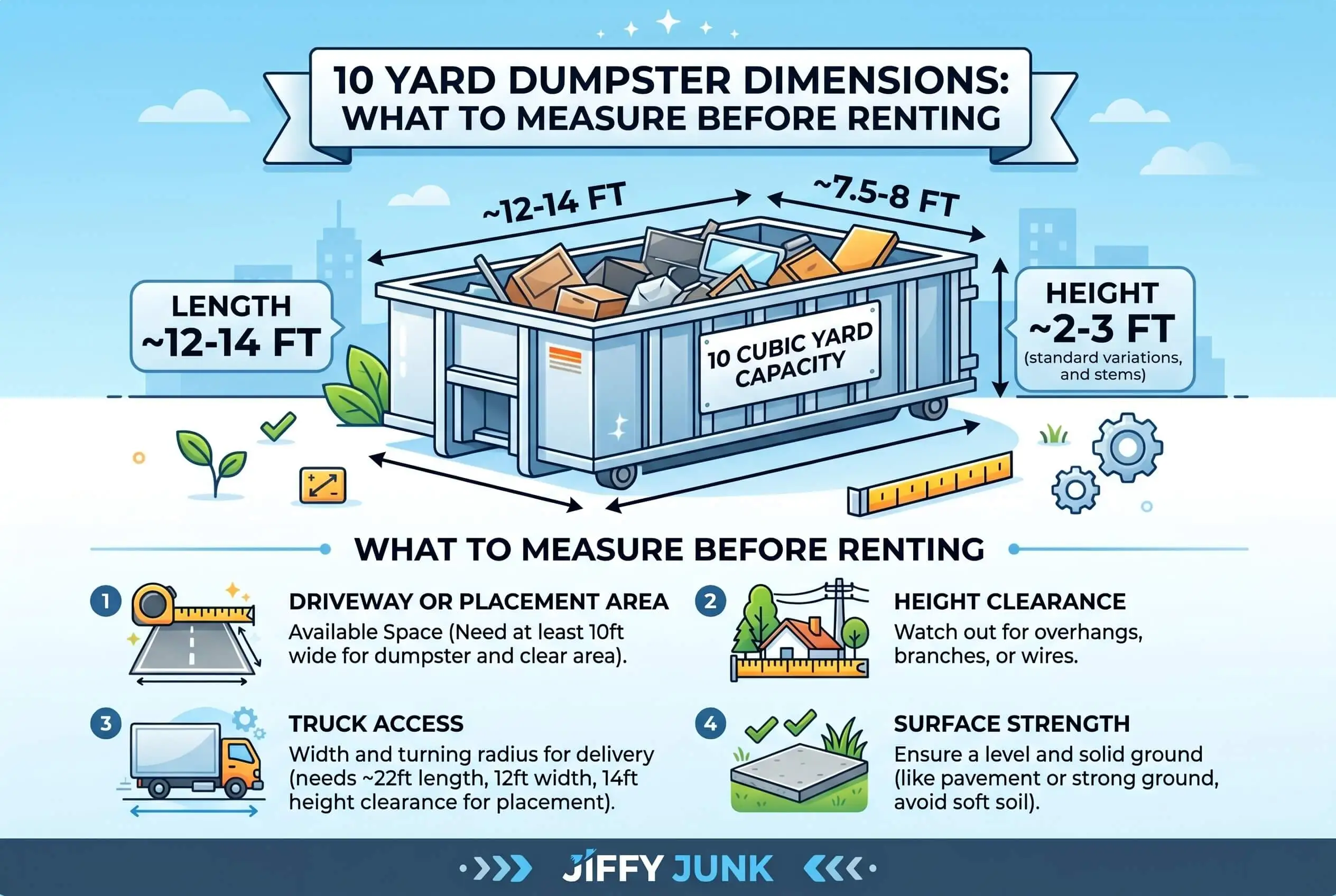
A standard 10 yard dumpster, hauled in as a roll-off container, runs about 12 feet long, 8 feet wide, and 4 feet tall. Dimensions vary slightly by hauler. Some companies run units closer to 11 × 7.5 × 3.5 feet. Others use a longer 14 × 7.5 × 3.5 foot frame. Confirm exact specs with your provider before delivery day.
The 4-foot height matters more than people expect. Most adults can toss debris over the side without a ramp or ladder, which makes loading faster and far less taxing on a long cleanout day.
In practical capacity terms, a unit this size holds:
About 3 standard pickup truck loads
50 to 70 large (33-gallon) trash bags
The contents of a single-car garage
Roughly 1,500 square feet of asphalt shingles
Weight allowance typically runs 1 to 2 tons (2,000 to 4,000 pounds). That figure trips up most homeowners, and I'll get to why in a minute.
What to Measure Before Delivery Day
Before you finalize a booking, walk your property with a tape measure and confirm five things. Skipping this step is the single most common cause of failed deliveries I've seen.
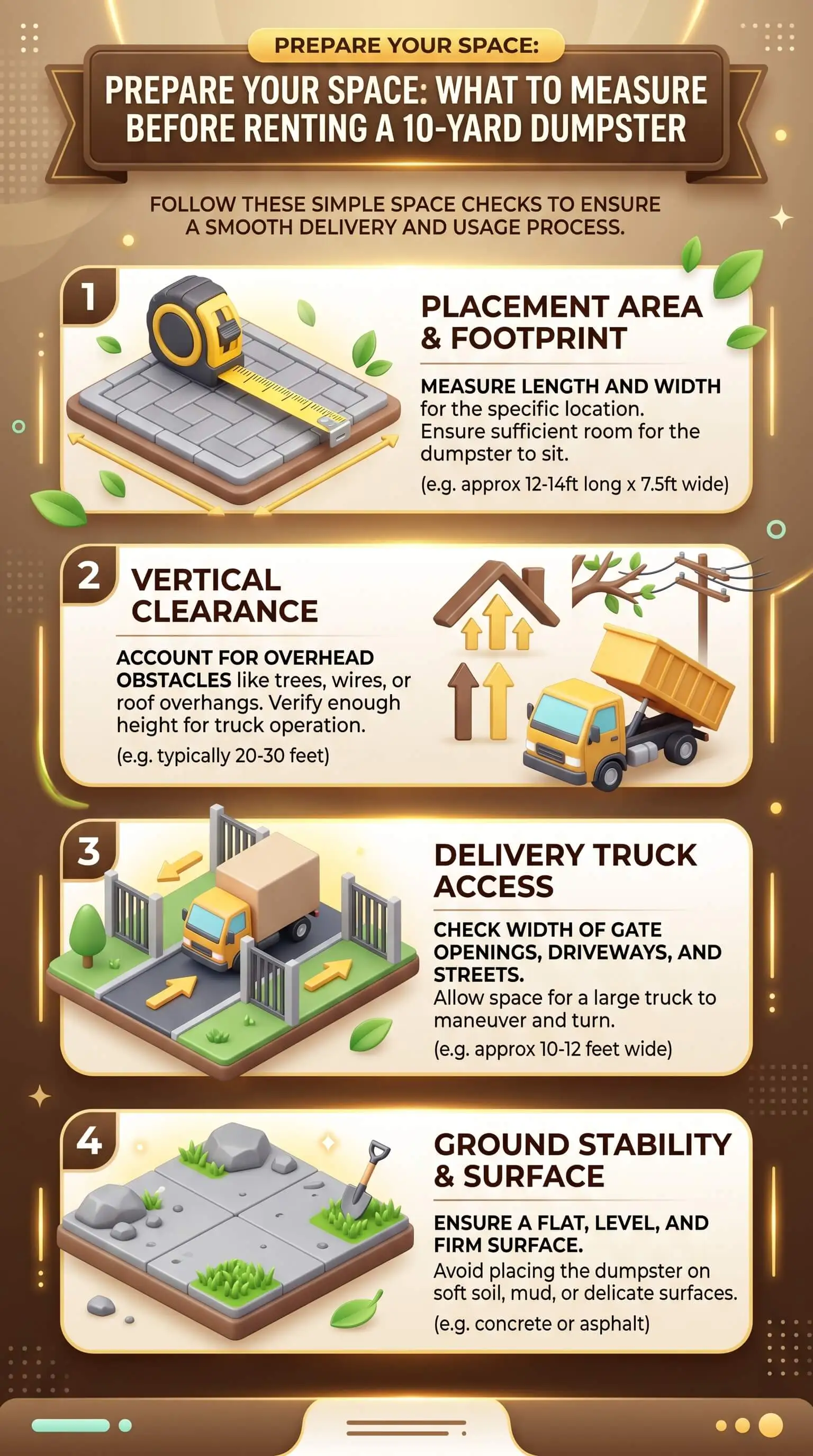
The drop zone itself. You need at least 14 by 10 feet of usable space. The container takes 12 by 8. The extra room lets the rear doors swing open and gives you walking space around all sides while loading.
Overhead clearance of 22 feet, minimum. Roll-off trucks lift the container at a steep angle to slide it off the bed. Low-hanging power lines, tree branches, and roof eaves are the most common reason a delivery gets aborted on site.
Driveway approach width of 10 to 12 feet. The truck needs a straight, clear path to back in. Tight corners, parked cars, and narrow gates all count as obstructions.
Surface and slope. Roll-offs need a near-level surface to seat correctly. Grass placement is risky in wet weather because the skids can sink. Protect decorative concrete and pavers with plywood beneath the rails.
Setback distance of 3 to 5 feet. Leave that buffer between the container and the house, fence, and parked vehicles. The margin protects your structures from accidental contact and gives the truck room to maneuver during pickup.
How Much Actually Fits Inside (Weight Beats Volume)
The counterintuitive part: volume rarely fills first. Weight does.
A 10 yard dumpster looks deceptively spacious. But it can hit the 2-ton weight ceiling long before it appears full when you're disposing of dense materials.
Watch the weight on:
Concrete: about 150 lbs per cubic foot
Asphalt shingles: 180 to 240 lbs per square (100 sq ft) for standard three-tab; architectural runs similar; slate runs much heavier
Ceramic tile: adds substantial weight quickly when you're tearing out a bathroom
Soil and dirt: about 100 lbs per cubic foot
For lighter materials like cardboard, furniture, and household debris, you'll usually max out the volume well before weight becomes an issue.
When 10 Yards Works, and When to Size Up
Across cleanout projects I've seen, a 10 yard container is the right call for:
Single-room renovations like bathroom or kitchen remodels
Garage cleanouts with years of accumulated household items
Small roof tear-offs under 1,500 square feet
Moderate landscaping work
Pre-move decluttering and downsizing
Size up to 15 or 20 yards for a whole-house cleanout, multi-room remodel, or any meaningful demolition. The cost difference between sizes usually runs $50 to $100. That's almost always cheaper than scheduling a second haul. For a side-by-side breakdown of every roll-off size and pricing tier, Jiffy Junk's complete 10 cubic yard dumpster guide walks through the full comparison.
"After coordinating dozens of residential cleanouts, I've found that measurements matter more than the size category itself. A 10 yard dumpster fits the vast majority of single-room projects, but only when the homeowner has actually walked the route the truck will take, not just the spot where they want it parked. A tape measure catches problems the eyeball misses every single time. The two oversights I see most often are power lines crossing the driveway and gate posts that turn out six inches narrower than the homeowner remembered."
7 Essential Resources
These seven resources will save you time, money, and at least one frustrated phone call. Bookmark them before you finalize a rental.
1. Roll-Off Dumpster Size Comparison
A side-by-side look at every standard roll-off size from 10 to 40 yards. Useful when you're on the fence between two sizes.
Source: Dumpsters.com | https://www.dumpsters.com/sizes/roll-off-dumpster-sizes
2. Debris Weight Calculator
Estimate the weight of common debris types before you load. The single best tool for avoiding overage fees on heavy-material projects.
Source: Budget Dumpster | https://www.budgetdumpster.com/resources/dumpster-weight-calculator.php
3. Prohibited Items Guide
A complete list of materials that can't legally go into a roll-off container. Tossing prohibited items can trigger rejection fees or full-load surcharges.
Source: Dumpsters.com | https://www.dumpsters.com/resources/prohibited-items
4. Dumpster Placement Permit Guide
When you need a permit for street placement, what it costs ($20 to $150 in most municipalities), and how long approval takes. Plan one to two weeks of lead time.
Source: Budget Dumpster | https://www.budgetdumpster.com/resources/permits.php
5. Household Hazardous Waste Disposal
The EPA's directory for safely disposing of paints, batteries, chemicals, and other items that can't go into any dumpster. Find drop-off programs in your zip code.
Source: U.S. Environmental Protection Agency | https://www.epa.gov/hw/household-hazardous-waste-hhw
6. National Pricing Reference
A breakdown of what drives 10 yard dumpster rental costs across U.S. markets. Useful for sanity-checking your quote against the regional average.
Source: Hometown Dumpster Rental | https://www.hometowndumpsterrental.com/blog/10-yard-dumpster-guide
7. Capacity Visualization Guide
Translates abstract "cubic yards" into pickup truck loads and trash bag counts. Easier to picture before you commit to a size.
Source: Waste Connections | https://www.wasteconnections.com/dumpster-sizes/
3 Statistics
These numbers show what's happening at scale across the country and why right-sizing your rental matters more than most people realize.
1. Construction and demolition debris totals 600 million tons annually.
The EPA reports that C&D debris in the U.S. is more than double the volume of all household municipal solid waste combined. Demolition activities alone account for over 90 percent of that total. Renovation projects are a major contributor, which is exactly why right-sizing your dumpster on a remodel matters environmentally, not just financially, while also helping create cleaner, safer conditions that support effective professional pest control services.
Source: EPA — Sustainable Management of Construction and Demolition Materials
2. Americans generate 292.4 million tons of municipal solid waste each year, and 50% of it gets landfilled.
That works out to roughly 4.9 pounds per person per day. Right-sizing your dumpster matters not just for your wallet, but because under-sized rentals frequently lead to mixed loads that bypass recycling streams entirely. Picking the appropriate size on the first try keeps more material in the recycling pipeline.
Source: EPA — National Overview: Facts and Figures on Materials, Wastes and Recycling
3. The U.S. has more than 2,600 active municipal landfills, with capacity varying widely by region. [VERIFY]
Some regions have decades of landfill capacity remaining. Others are scrambling to site new facilities. As regional landfills fill, tipping fees rise, and those increases roll directly into the rental quotes haulers offer. That's why dumpster pricing in the same size category can vary by hundreds of dollars between metro markets.
Source: EPA — LMOP Landfill and Project Database
Final Thoughts and Opinion
The homeowners I see with the smoothest dumpster rentals treat the measurement step as non-negotiable. They walk the truck's route. They check overhead clearances. They verify driveway slope. None of it takes more than fifteen minutes. But it's the difference between a rental that runs on schedule, helps you get the best value from dumpster rental prices, and one that ends with the driver shaking his head and calling dispatch.
The other big takeaway: weight is almost always the limit, not volume. Most people underbook tonnage and overbook capacity. If your project involves any meaningful quantity of concrete, tile, shingles, or soil, plan around the weight allowance first and the cubic yards second. I've watched homeowners pay $150 in overage fees on a dumpster that looked half empty.
If your project is contained enough that a 10 yard dumpster sounds tempting but you'd rather skip the loading, the permits, and the rental window altogether, full-service junk removal often comes in at a similar price for a single-load job. Worth getting both quotes before deciding which path makes sense for your situation.
Frequently Asked Questions
What are the exact dimensions of a 10 yard dumpster?
A standard 10 yard dumpster runs roughly 12 feet long, 8 feet wide, and 4 feet tall. Dimensions vary slightly by hauler. Some run 11 × 7.5 × 3.5 ft, others 14 × 7.5 × 3.5 ft. Confirm exact specs with your provider before delivery.
How much driveway space do I need for a 10 yard dumpster?
You need at least a 14 × 10 foot footprint to fit the container's 12 × 8 ft size plus rear-door swing and walking room. Driveway approach should run 10 to 12 feet wide and unobstructed, with at least 22 feet of overhead clearance for the delivery truck.
What is the weight limit on a 10 yard dumpster?
Most providers cap a 10 yard rental at 1 to 2 tons (2,000 to 4,000 pounds). Heavy materials like concrete, tile, and roofing shingles will hit that ceiling long before the container appears full. Use a weight calculator before booking if your project involves dense debris.
Can I put a 10 yard dumpster on the street?
In most municipalities, yes, but you'll need a permit. Permit fees typically run $20 to $150, and processing can take one to two weeks. Always check with your local public works department before booking, and confirm whether your HOA has additional restrictions.
How many trash bags fit in a 10 yard dumpster?
Roughly 50 to 70 large (33-gallon) trash bags. Loose, bulky items take up more space than bagged debris, so the count drops noticeably when you're tossing furniture, appliances, or large boxes.
Is a 10 yard dumpster big enough for a garage cleanout?
For most single-car garages with years of accumulated household items, yes. Two-car garages or cleanouts that include heavy yard waste, building materials, or large furniture often call for a 15 or 20 yard size to avoid a second haul.
Ready to Measure and Book?
Once you've measured your space and confirmed the size you need, the next step is booking with a hauler who'll give you a transparent quote. Weight allowance included. No overage surprises tucked into the fine print.
If you'd rather skip the rental window, the permit application, and the heavy lifting altogether and have a full-service team handle the loading and disposal in a single visit, Jiffy Junk's complete 10 cubic yard dumpster guide walks through both options side by side, including a national pricing breakdown and project-type recommendations.
Whichever route you pick, you've now got everything you need to avoid the most common (and most expensive) measurement mistakes on delivery day. Pull out the tape measure before you pull out the credit card.