On a trip, that matters more than it does at home. Sensitive hands usually make it through day one, and somewhere around the second morning the knuckles start to split. The soap takes the blame, and sometimes it's earned it, because a bottle labeled hypoallergenic hand soap can still carry fragrance or a harsh surfactant that sets off reactive skin. Cold mornings and a lot more sanitizer than you'd use at home do the rest.
So skip the label and read the ingredients. The useful question is which soap leaves out what your skin can't handle, and whether it needs water you might not have.
TL;DR Quick Answers
hypoallergenic hand soap
Hypoallergenic hand soap is soap a manufacturer markets as less likely to cause allergic reactions. The FDA has no federal standard for the term, so the ingredient list tells you far more than the label does.
What to look for:
Fragrance-free, not just "unscented"
SLS-free and alcohol-free
Paraben-free and dye-free
Plant-based ingredients
Independent lab testing behind any germ claim
Best pick for sensitive skin outdoors: a rinse-free formula that physically lifts germs off your hands. It needs no water and skips the wet-dry cycle that often triggers hand eczema.
Bottom line: Skip the label. Read the ingredients.
Top Takeaways
No federal standard defines "hypoallergenic," and companies don't have to prove the claim before they print it.
Camping piles on known hand eczema triggers, from cold, dry air to extra rounds of alcohol sanitizer.
Choose a hypoallergenic hand soap for camping by its ingredient list, which should skip fragrance, SLS, alcohol, and dyes.
Fragrance-free toiletries go easier on reactive skin and give insects and wildlife one less reason to visit your site.
Keep every kind of soap at least 200 feet from lakes and streams, biodegradable formulas included.
A rinse-free waterless soap cuts out both the wet-dry cycle and the wastewater, though soap and running water still come first whenever you have them.
What Does "Hypoallergenic" Actually Mean on a Hand Soap Label?
Legally, nothing you can count on. The word tells you a company believes its product causes fewer allergic reactions, and the FDA says no federal standard or definition backs it up.
The agency did try. The FDA proposed a testing requirement in 1974 and finalized it in 1975. Almay and Clinique sued, and in 1977 a federal appeals court threw the rule out, leaving companies free to print the word without proof. This overview of what "hypoallergenic" actually means walks through the full history.
Northwestern dermatology researchers put those labels to the test in 2017. They found that 15 of the 18 best-selling moisturizers marketed as hypoallergenic contained at least one known contact allergen, and nearly half the products sold as fragrance-free held a fragrance cross-reactor or botanical.
The ingredient list is the one part of the package a manufacturer has to get right. Start there.
Why Is Camping Harder on Sensitive Hands Than Home?
A weekend outdoors stacks known eczema triggers on top of each other. The National Eczema Association names frequent contact with water and soap, fragrances, cold weather, and low humidity as common hand eczema triggers, and a campsite can hit you with all of them by Saturday afternoon.
Sanitizer piles on. With water rationed, most campers lean on alcohol gel, and the American Academy of Dermatology warns that it can be very drying. A wet rinse at breakfast and a squirt of gel at the trailhead add up fast. Reactive skin feels every round of that wet-dry cycle.
At home you'd fix it with lukewarm water, a clean towel, and a tube of cream by the bed. Outdoors, you plan for it before you leave. If dry, cracking skin bothers you all year, our guide to the best soap for sensitive skin covers everyday care.
What Should You Look for in a Hypoallergenic Hand Soap for Camping?
Judge a soap by what it leaves out. Run through this list before anything goes in the pack.
Fragrance-free on the ingredient list, since an "unscented" front label can still hide a masking fragrance
Free of sodium lauryl sulfate, the irritant dermatologists use as a standard in patch testing. Our breakdown of SLS-free soap explains what changes without it.
Alcohol-free, because your sanitizer already brings plenty
Free of parabens and dyes, which don't help anything get clean
A short ingredient list you can read by headlamp
A leak-proof container that fits the 3.4-ounce [VERIFY] carry-on limit if you're flying to the trailhead
Independent lab testing behind any germ-removal number on the bottle
One more reason to go fragrance-free has to do with pests, which is why a pest control site cares about soap at all. Scented toiletries can draw insects and curious animals toward your tent, and in bear country, park rules have you store them with your food. Unscented gear gives the local wildlife one less reason to come investigate.
Which Soap Format Works Best Outdoors?
Each format fixes one problem and hands you another. Here's how they compare for sensitive skin.
Liquid biodegradable camp soap is the classic pick for dishes and full washes. It needs water and a rinse, and you'll have to carry the wastewater 200 feet from any lake or stream. Check the label for fragrance before trusting it on reactive hands.
Soap sheets weigh almost nothing, which ultralight hikers love. Many are scented, though, and they still need water.
Castile soap handles a bit of everything at basecamp. Some people find it drying.
Alcohol hand sanitizer needs no water and covers quick cleanups when your hands already look clean. Reactive skin usually pays for it later.
Wet wipes earn their spot for sticky messes. Plenty contain alcohol or fragrance, and you have to pack out every used wipe.
Rinse-free waterless soap works without water and leaves no wastewater behind. Its gentleness depends entirely on the formula, so look for plant-based and fragrance-free.
If gel sanitizer is your trail default, learn how to tell if your hand sanitizer kills E. coli before your next trip.
Where Does Soap Go When You're Done?
Keep it out of the water. Leave No Trace asks campers to keep all soap out of lakes and streams, biodegradable soap included, because even biodegradable formulas can take six months to several years to break down in water. While soap lingers there, it adds nutrients and shifts the water's pH.
Distance solves most of it. Carry your water at least 200 feet from the source, about 70 big steps, and use as little soap as you can. Strain out any food bits, then scatter the wastewater widely or pour it into a cathole 6 to 8 inches [VERIFY] deep.
A rinse-free product skips that routine entirely, since you have nothing to carry off and dump.
How a Waterless Hypoallergenic Hand Soap Fits a Camp Routine
A waterless soap lifts dirt and germs off your skin so you can brush them away without a rinse or any runoff. Sanitizer takes a different approach. It kills germs and leaves everything, alcohol included, sitting on your hands.
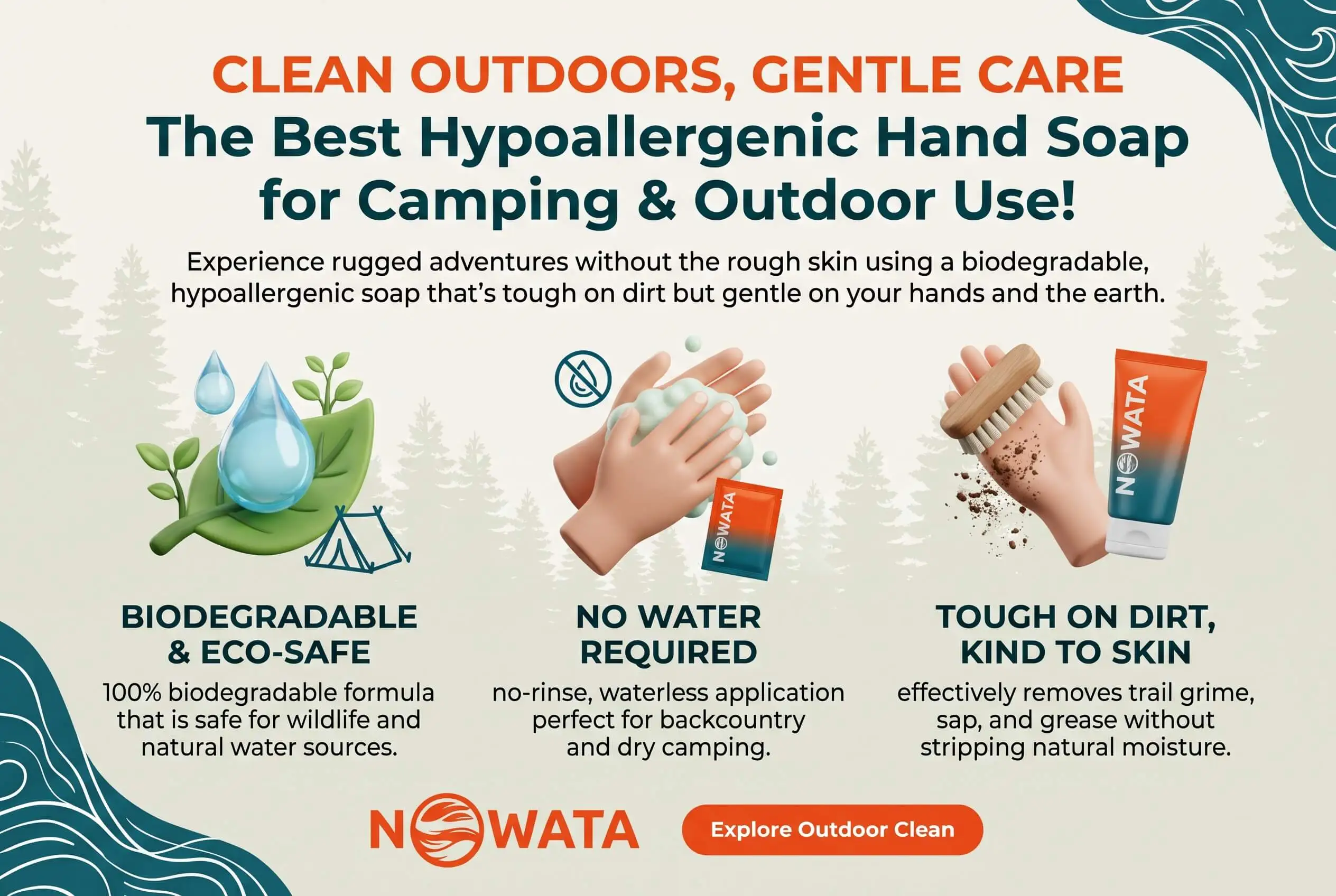
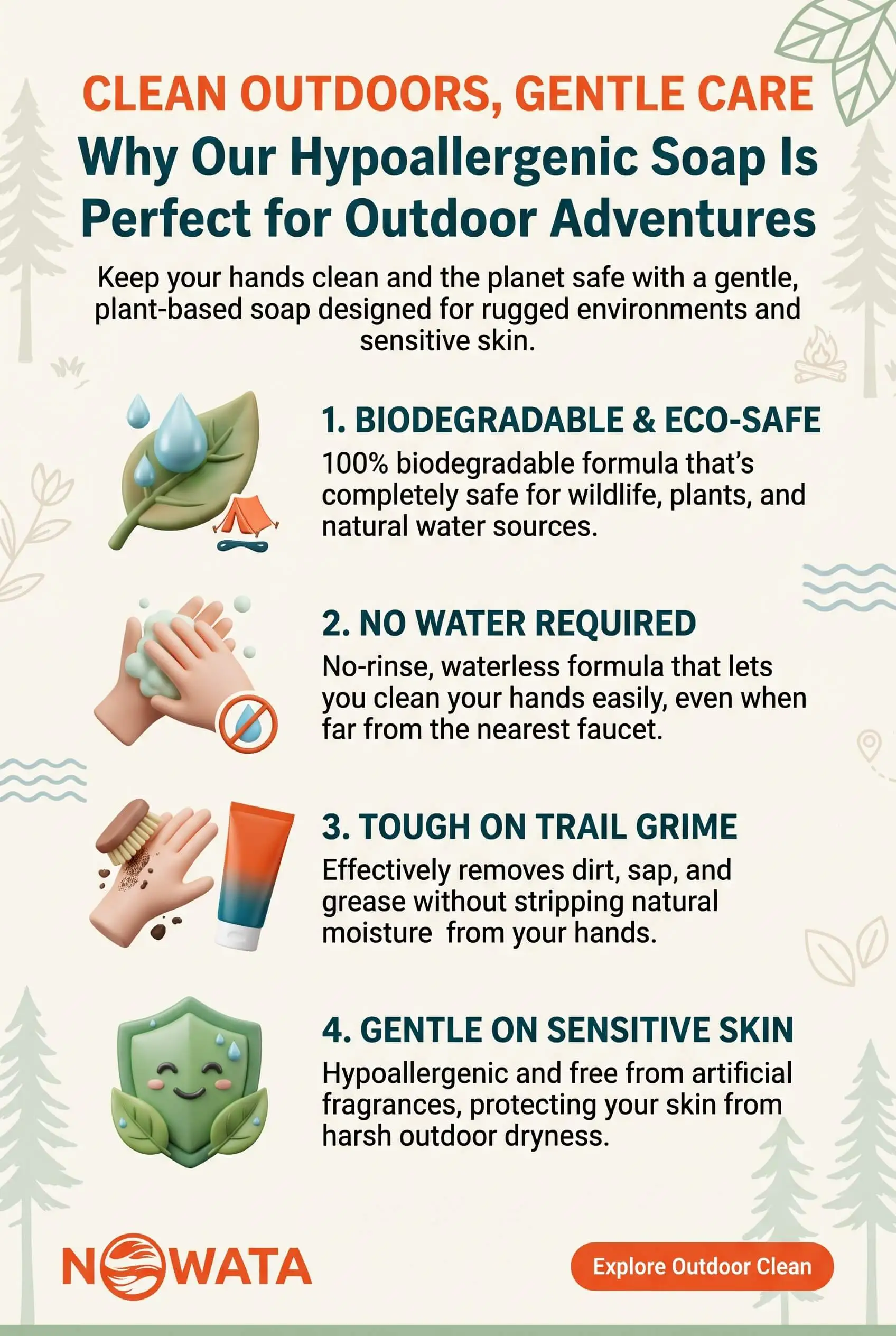
NOWATA's founders built their formula for exactly that gap. Dentist Dr. Ruslan Maidans and biomedical engineer Dr. Yalda Shahriari watched their own kids flinch at the sink, and they stood at trailheads with dirty hands and no water in sight. They made their plant-based hypoallergenic hand soap without SLS, alcohol, synthetic fragrance, or parabens. In Swiss lab testing, it physically removed over 99.9%* of the bacteria and virus particles tested from skin.
Using it takes three steps.
Squeeze a small drop onto dry hands.
Rub for 15 to 20 seconds until small clumps form.
Brush the clumps away, and the dirt goes with them.
One bottle covers 80 to 100 uses, so it easily outlasts a long weekend.
The CDC would add a caveat, and so will I. When you've got soap and clean running water, use them. A waterless option covers the stretches in between, like a mid-hike snack or a dry campsite where every liter goes to drinking.
What Goes in a Sensitive-Skin Camp Hygiene Kit?
Keep it small. Five things earn a spot.
A fragrance-free, SLS-free soap for full washes at camp
A waterless cleanser for the trail
A fragrance-free moisturizer in a tube, which the AAD says tends to irritate chapped skin less than a pump bottle
A small trowel for catholes
A sealed bag for anything scented, stored with your food
*Based on laboratory testing using a modified ASTM E1174 test, NOWATA physically removed over 99.9% of virus (Murine Norovirus, a human norovirus surrogate) and bacteria (E. coli) particles from skin. Results do not imply disease prevention. For hand cleansing only.
"The camping question I hear most is why someone's hands cracked when they packed the gentle soap. Usually the soap is only part of the story, and cold air plus a sanitizer habit does the rest. My advice has gotten plain over the years. Read the back of the bottle instead of the front. Pack something fragrance-free, carry a waterless option so you aren't reaching for alcohol gel six times a day, and put moisturizer on before you crawl into the sleeping bag. It won't win any awards for excitement. It does hold up on the third morning far better than a bottle with hypoallergenic printed in big letters, because nobody but the company selling it ever checked that word."
7 Essential Resources
I go back to these sources whenever a reader pushes back on something I've said about soap labels, sensitive skin, or washing up outdoors. I've checked every link.
Wikipedia, Hypoallergenic. The history of the word, from early cosmetics advertising to why no government certifies it today. Start here if the label has ever confused you. en.wikipedia.org/wiki/Hypoallergenic
FDA, "Hypoallergenic" Cosmetics. The regulator says it outright. No federal standard exists, and companies don't have to prove the claim. The page also covers how the 1975 rule died in court. fda.gov/cosmetics/cosmetics-labeling-claims/hypoallergenic-cosmetics
CDC, About Handwashing. The CDC's five-step method, along with its fallback for when you can't get to soap and water. Useful for knowing what good enough looks like on a trail. cdc.gov/clean-hands/about
Leave No Trace, How to Do Your Dishes in the Backcountry. Where the 200-foot rule comes from, why biodegradable soap still hurts water, and how to get rid of wash water properly. lnt.org/skills-series-how-to-do-your-dishes-in-the-backcountry
National Eczema Association, Hand Eczema. Types, triggers, and day-to-day care for reactive hands. Cold weather, low humidity, and fragrance all appear on its trigger list. nationaleczema.org/body/hand-eczema
American Academy of Dermatology, Dry Skin Relief From Handwashing. Dermatologists lay out a routine for washing without wrecking your skin and remind you to moisturize right after sanitizer dries. aad.org/public/everyday-care/skin-care-basics/dry/coronavirus-handwashing
Backpacker, Your "Biodegradable" Soap Isn't As Eco-Friendly As You Think. An outdoor writer takes apart the biodegradable myth and shares practical ways to wash up without fouling lakes and streams. backpacker.com/skills/your-biodegradable-soap-isnt-as-eco-friendly-as-you-think
3 Statistics
When readers want numbers instead of opinion, I reach for these.
15 of 18 products sold as "hypoallergenic" still contained a potential allergen. Northwestern researchers reviewed 174 best-selling moisturizers from Amazon, Target, and Walmart for a 2017 JAMA Dermatology study. That works out to 83% of the hypoallergenic-labeled products carrying at least one ingredient from the standard contact dermatitis allergen series. Source: JAMA Dermatology via PubMed Central
Biodegradable soap can take six months to several years to break down in water. Leave No Trace adds that while soap lingers, it feeds extra nutrients into lakes and streams and shifts their pH. Biodegradable describes what happens in soil over time, and a creek works differently. Source: Leave No Trace
About 14.5% of people worldwide experience hand eczema. The National Eczema Association names frequent water and soap exposure, fragrances, cold weather, and low humidity among its common triggers, which reads a lot like a packing list for a fall camping trip. Source: National Eczema Association
Research shows that hypoallergenic products may still contain allergens, biodegradable soap can affect waterways, and frequent soap exposure can trigger hand eczema. Choosing gentle, skin-friendly products is especially important during camping, outdoor cleaning, or activities involving a professional pest control service.
Final Thoughts and Opinion
I'd stop treating "hypoallergenic" as a reason to buy anything. Nobody regulates the word or checks it, and the Northwestern study caught it falling short on 15 of 18 labeled products. That says less about any single brand than about a term nobody has to back up.
For the best hypoallergenic hand soap for camping, the formula matters far more than the label. I want fragrance and SLS gone, with no alcohol in the soap itself and an ingredient list I can read in a tent without squinting.
Water is the other half of the decision. Most camp soap needs a rinse, and that rinse needs a plan for keeping suds out of the creek. That's why I'd pack two things, a gentle soap for full washes at camp and a waterless option for the trail. Expect the second one to see more use than you'd guess.
When clean running water is right there, use it. Soap and water is still the standard, and waterless products exist for long stretches outdoors when you don't have it.
Your hands work hard on a trip. Give them a soap that doesn't add to the job.
Frequently Asked Questions
Is there an official definition of hypoallergenic hand soap?
No. The United States has no federal standard for the word. The FDA set one in 1975, and a federal appeals court struck it down in 1977, so any company can print "hypoallergenic" without testing. Read the ingredient list instead.
Is biodegradable soap safe to use in a lake or stream?
No. Leave No Trace asks campers to keep all soap out of water sources, because biodegradable soap can take months to years to break down there. Wash at least 200 feet away, then scatter the strained water or bury it in a cathole.
Is hand sanitizer a good option for sensitive skin while camping?
It does the job, but reactive skin often pays for it. The CDC's fallback is a sanitizer with at least 60% alcohol, and dermatologists warn that it can be very drying. Moisturize once it dries, or carry an alcohol-free waterless cleanser for the times you'd otherwise grab the gel.
How do you clean your hands outdoors without water?
Use a rinse-free waterless soap. Rub a small drop into dry hands for 15 to 20 seconds until it clumps, then brush the clumps off. You end up with clean hands and no wastewater, though soap and clean running water remain the better choice whenever you can get them.
Does fragrance-free soap attract fewer bugs and animals at camp?
It removes one attractant, which helps. Scented products can draw insects and wildlife, but going fragrance-free won't repel anything by itself. In bear country, store all toiletries with your food, scented or not.
What's the best hypoallergenic hand soap for kids on a camping trip?
The same kind you'd want for yourself, meaning fragrance-free, SLS-free, alcohol-free, and plant-based. Kids grab everything and rinse half-heartedly, so a waterless option they can use at the picnic table makes life easier. If your child has eczema, ask their pediatrician or dermatologist first.
CTA
Before your next trip, pull the soap out of your camp kit and read the back of the bottle. If the list runs long or is packed with names you can't pronounce, swap it out before you hit the trail.
For a reference point, NOWATA's guide to gentle hypoallergenic hand soap spells out what the founders put into their rinse-free formula and what they kept out of it. Hold whatever you pack now up against it.
Got a trail-tested routine that keeps your hands from cracking? Leave it in the comments. I read them, and the best tips usually come from readers who've logged more nights outside than I have.